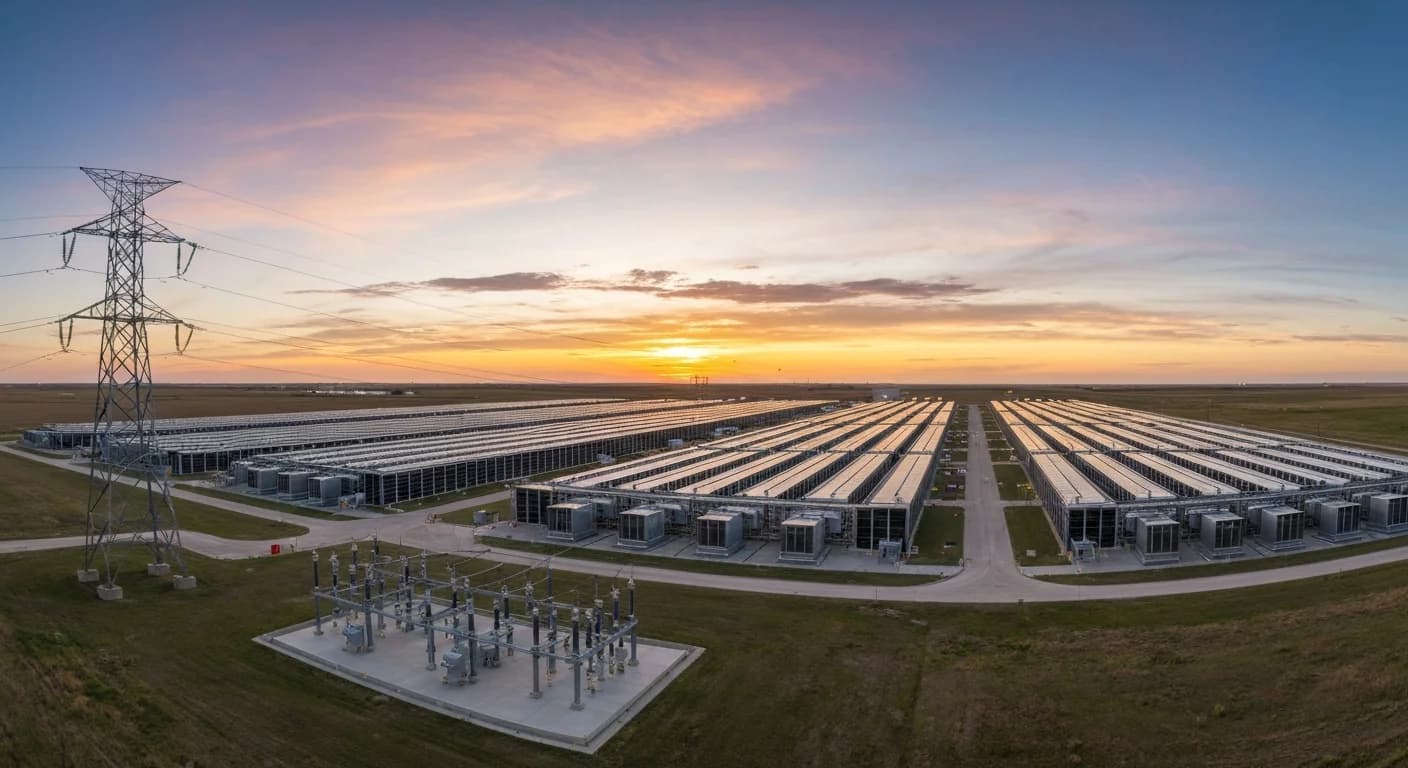
Applied Digital (NASDAQ: APLD) has signed a 15-year take-or-pay lease worth roughly $7.5 billion in base-term contracted revenue — and up to $18.2 billion if every renewal option is exercised — for 300 MW of critical IT load at Polaris Forge 3, its fourth AI Factory campus, which the company says is located in an undisclosed "northern state." The agreement pushes the company past 1 GW of contracted capacity for the first time and lifts total booked lease revenue to $31 billion across four campuses, or $73 billion with renewals.
The terms
The 300 MW of critical IT load is backed by roughly 430 MW of grid-connected utility power — the gross-to-net overhead that determines how much wall power a campus actually has to secure. It is the company's second 300 MW lease with the same undisclosed "U.S.-based high investment-grade hyperscaler," following Delta Forge 1 in April 2026. Take-or-pay means the tenant owes the contracted minimum whether or not it draws the capacity — the structure that lets Applied Digital finance the build against guaranteed cash flow. Initial operations are slated for August 2027.
A two-track tenant base
Applied Digital now runs two distinct customer profiles. Polaris Forge 1 is leased to CoreWeave — roughly 400 MW across three agreements worth about $11 billion — a neocloud whose balance sheet leans on GPU-backed debt. The newer leases (Polaris Forge 2 at $5 billion / 200 MW, plus Delta Forge 1 and Polaris Forge 3) are with the unnamed investment-grade hyperscaler. That credit-quality split matters: an investment-grade counterparty on a take-or-pay contract is the collateral lenders want, and it is why analysts at Needham and Compass Point moved on the stock after the announcement.
Power is the real constraint
The 430 MW of utility power behind 300 MW of IT is the tell. With hyperscalers and neoclouds competing for the same interconnects, the scarce input is no longer GPUs alone but megawatts that can actually be energized on a 2027 timeline. Chairman and CEO Wes Cummins framed the second 300 MW commitment as validation of Applied Digital's execution on large-scale interconnection and construction — the part of the stack that can't be spun up on demand.
What it signals
For anyone planning 2027 capacity, the read-through is that frontier-scale compute is being locked in years ahead through long-dated, take-or-pay paper, increasingly on rural grids with spare headroom. The marginal gigawatt is being booked by investment-grade balance sheets, not spot-market renters — a sign the buildout's financing is consolidating around counterparties that can underwrite 15-year commitments. Capacity that isn't contracted now may simply not exist when models scheduled for 2027 training runs need it.