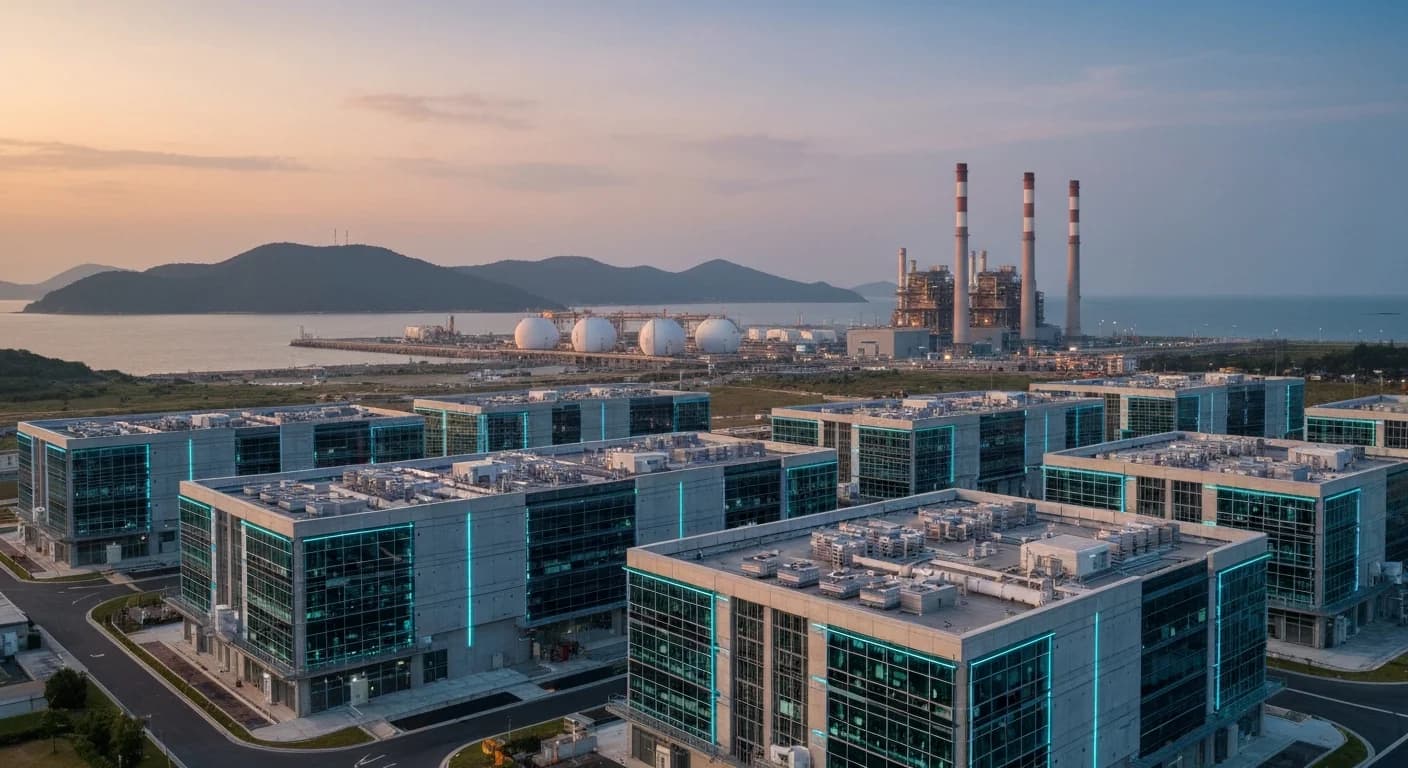
SK Group used the Korea–Vietnam Business Forum in Hanoi to sign two memoranda of understanding that commit the Korean conglomerate to building AI data center infrastructure in Vietnam's Nghe An province — and to plug that infrastructure directly into a 1.5-gigawatt LNG power project SK Innovation was recently picked to develop. The deal is the first overseas application of what SK calls its 'AI full-stack provider' strategy.
The agreements were signed in the presence of South Korea's Minister of Trade, Industry and Resources, Kim Jung-kwan, and Vietnam's Minister of Finance, Ngo Van Tuan. SK Chairman Chey Tae-won attended alongside the chief executives of SK Innovation and SK Telecom, and Nghe An Provincial People's Committee Chairman Vo Trong Hai signed on the Vietnamese side.
A full-stack play, exported
SK's pitch is that it can sell the whole AI stack instead of a single layer. 'SK will make a substantial contribution to the development of Vietnam's AI industry by leveraging our portfolio capabilities across the entire AI ecosystem, ranging from energy and semiconductors to AI models and application services,' Chey said, framing the Vietnam deal as an integrated offer rather than a pure real-estate or utility play.
Under the MOUs, SK Innovation and SK Telecom will jointly explore an AI data center (AIDC) and related infrastructure in Nghe An, with SK Innovation leading on power solutions and SK Telecom leading on data center development and operations. A parallel agreement with Vietnam's National Innovation Center extends the relationship to model development, validation, and industry-specific AI services. SK had already seeded the NIC with a $30 million contribution back in 2019, giving it a foothold for this expansion.
Power is the moat
The energy piece is the part competitors will find hardest to copy. SK Innovation will explore supplying the Nghe An AI campus directly from the Quynh Lap LNG Power Project — a roughly 1.5-gigawatt gas-fired combined-cycle plant paired with an LNG import terminal and a dedicated port. Construction is scheduled to begin in 2027, with completion targeted for 2030.
That timeline matters. Global AI build-outs are increasingly gated by grid capacity rather than silicon supply, and hyperscaler projects in the U.S. and Europe are being pushed back by local permitting revolts and long power-queue waits. Nghe An, on Vietnam's north-central coast, gives SK a greenfield site where the data center and its generation asset can be engineered together from day one.
What it signals
For Vietnam, the deal slots the country further into the Asia-Pacific AI infrastructure map alongside Malaysia, Indonesia, and Thailand, all of which have been courting Korean, Japanese, and U.S. operators. For SK, it is a hedge against a domestic market where Korean data center permits have tightened and a proof point that the conglomerate can sell AI infrastructure abroad as a bundled offer — data center plus power plus model layer — rather than compete one layer at a time against Nvidia, Google Cloud, or regional telcos.
The MOUs are non-binding, and neither side disclosed a total investment figure or a target capacity for the AIDC itself. But the combination of a 1.5 GW captive power project, a state-aligned partner in NIC, and provincial buy-in from Nghe An gives SK an unusually vertical starting position for what could become one of Southeast Asia's larger AI campuses.