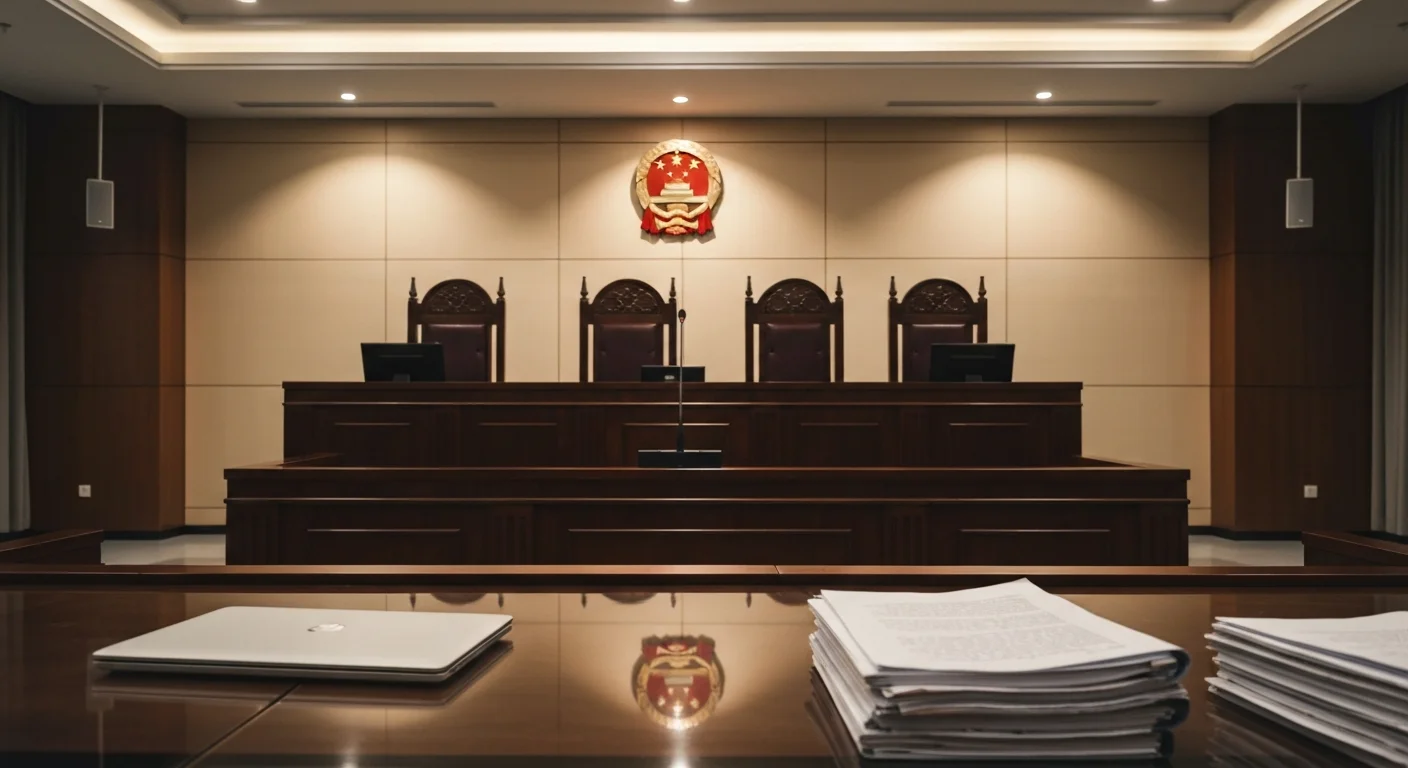
A Chinese court has ruled that companies cannot lawfully dismiss employees solely because their work has been automated by artificial intelligence, in a decision that adds a sharp new constraint to the global debate over AI-driven layoffs. The Hangzhou Intermediate People's Court upheld a lower-court finding that a tech company illegally fired a quality assurance worker after replacing his role with a large language model, according to reports published this weekend.
The ruling, which became widely known after Bloomberg, NPR and Caixin Global reported on it between April 30 and May 2, 2026, classifies AI adoption as a controllable business strategy rather than an unavoidable disruption — a distinction that carries significant weight under Chinese labor law.
The case
The employee, identified in court documents only by his surname Zhou, joined the company in November 2022 as a quality assurance supervisor on a monthly salary of 25,000 yuan, roughly $3,655. His work involved reviewing AI-generated outputs and filtering sensitive or illegal content. After the company adopted a large language model that automated much of that review work, it offered Zhou a lower-level position at 15,000 yuan per month — a roughly 40 percent pay cut. When he refused, the firm terminated his contract, citing reduced staffing needs and the impact of AI on the role.
The Yuhang District Court and the Hangzhou Intermediate People's Court both found the dismissal unlawful and ordered compensation. The Hangzhou court reasoned that the company's decision to deploy AI was a strategic business choice, not a "major change in objective circumstances" of the kind that can void an employment contract under China's Labor Contract Law.
A second precedent
The Hangzhou ruling follows a similar decision by a Beijing court in December 2025 involving a worker named Liu, who had been hired in July 2009 to do manual map data entry. After the firm switched to AI-based data collection in early 2024, Liu was let go. Beijing judges deemed the AI transition a deliberate business decision rather than an unforeseeable event, making the dismissal illegal.
Together, the two cases establish an emerging line of Chinese case law that places the legal and financial risk of AI deployment on employers rather than displaced employees.
Implications
The rulings arrive against a backdrop of accelerating AI-driven workforce restructuring. Tech-industry layoffs in the first quarter of 2026 reportedly exceeded 78,000 globally, with a significant share attributed to automation. By treating AI adoption as a voluntary strategic choice, Chinese courts are signalling that companies must look first to retraining, reassignment with reasonable compensation adjustments, or skill-development support before terminating staff.
The approach contrasts with the lighter-touch posture in many other jurisdictions, where AI-related layoffs are largely governed by general at-will or redundancy frameworks. For multinationals operating in China, the practical effect is immediate: severance and reorganisation plans built around AI cost savings will need to be re-examined, and restructurings framed as AI-driven may face heightened legal exposure.
Whether other Chinese courts adopt the same reasoning will determine how durable the precedent becomes — but for now, in two of the country's most economically important cities, automating a job is no longer, by itself, a legal reason to end one.