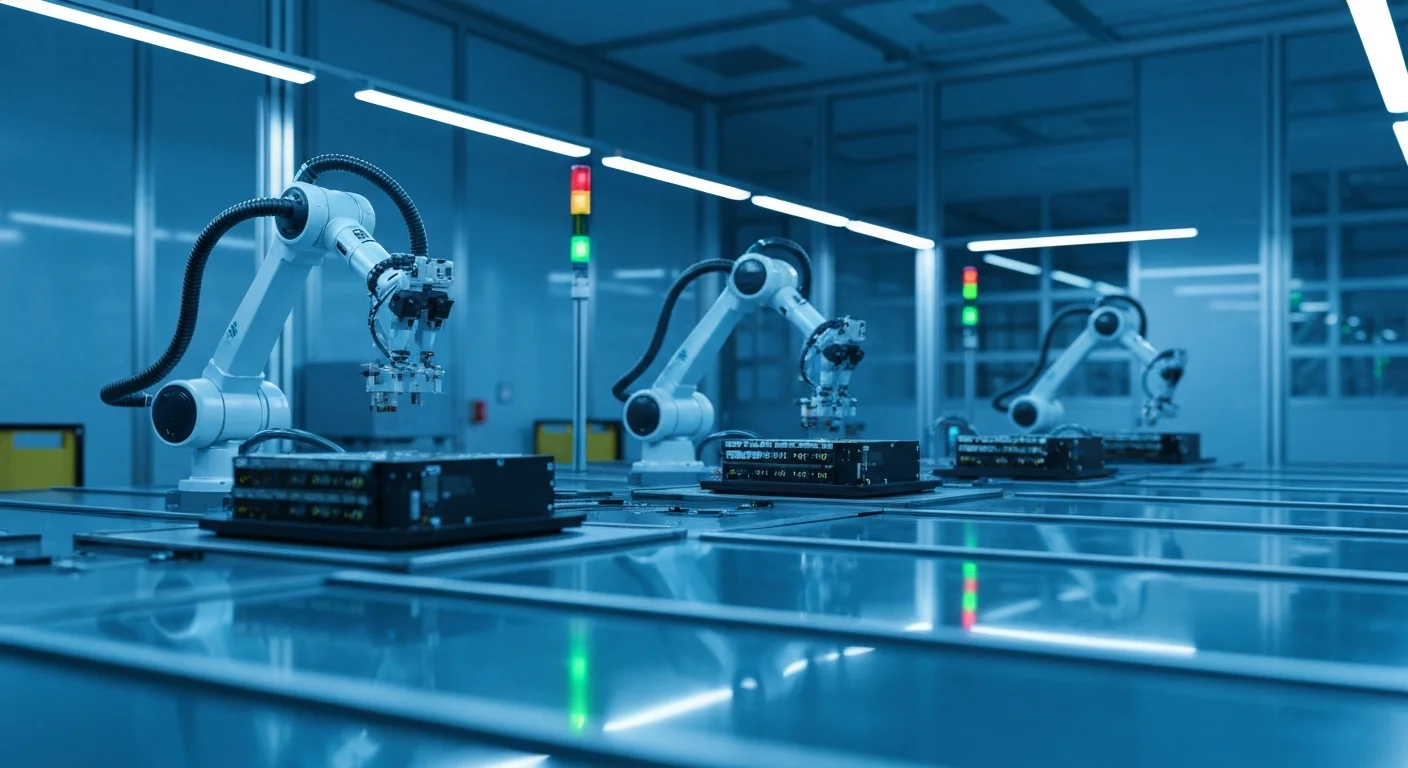
Nvidia's transition from a chip company to the platform layer of physical AI is rewiring the global hardware supply chain — and Asian markets felt it this week. Reports compiled by Bloomberg show that Asian suppliers now account for approximately 90% of Nvidia's production costs, a sharp jump from roughly 65% a year earlier, as Jensen Huang's pivot beyond data-center silicon into robotics, autonomous systems and AI-enabled manufacturing pulls a wider circle of partners into the company's orbit.
The market response was immediate. LG Electronics surged as much as 15% after reports that the Korean conglomerate would integrate its home robots with Nvidia's platform. Taiwan memory specialist Nanya Technology climbed 10% on partnership news. In China, Huizhou Desay SV Automotive and Pateo Connect Technology Shanghai both rallied after unveiling intelligent driving and connected-vehicle solutions tied to Nvidia hardware. Samsung's semiconductor division — already a beneficiary of the AI memory cycle — reported a 48-fold profit increase, while SK Hynix's quarterly earnings rose fivefold.
A new layer of dependence
For years, Nvidia's exposure to Asia centered on a tight ring of foundry and memory partners: TSMC for advanced logic, SK Hynix and Samsung for high-bandwidth memory, and Hon Hai for system assembly. The 90% figure suggests that ring is widening. Robotics platforms, automotive compute modules and edge inference systems all require the kind of precision manufacturing, packaging and component sourcing that is concentrated in Korea, Taiwan and parts of China.
Huang has framed physical AI as "the next major wave of artificial intelligence," pitching Nvidia not just as a chip vendor but as the operating system for machines that move, sense and act in the real world. That positioning is what drove the cross-asset reaction: investors are no longer pricing these companies as commodity hardware suppliers but as core nodes in an Nvidia-anchored physical-AI stack.
Hyperscaler money is the engine
The rally also reflects the scale of demand sitting behind Nvidia. U.S. hyperscalers — Amazon, Microsoft and Alphabet — have each individually committed close to $190–200 billion in AI capital expenditure this year, a combined total of roughly $570 billion, much of it routed through Nvidia hardware. Nvidia accounts for roughly half of Microsoft's capital expenditure footprint and around a quarter of Amazon's, giving its Asian partners an unusually visible demand signal compared with prior cycles.
Implications
For Asian governments, the data underscores both opportunity and vulnerability. Korea, Taiwan and China are now structurally embedded in the AI infrastructure buildout, but that concentration also raises the geopolitical stakes around export controls, advanced packaging capacity and robotics IP. For investors, this week's moves are a preview of what a physical-AI rotation looks like: the trade is no longer confined to GPU vendors and HBM suppliers — it now extends to home appliances, automotive electronics and component makers that, until recently, sat well outside the AI narrative.
If Nvidia's pivot holds, the share of its bill of materials flowing east is likely to keep climbing — and so is the list of Asian companies whose valuations move with Huang's roadmap.