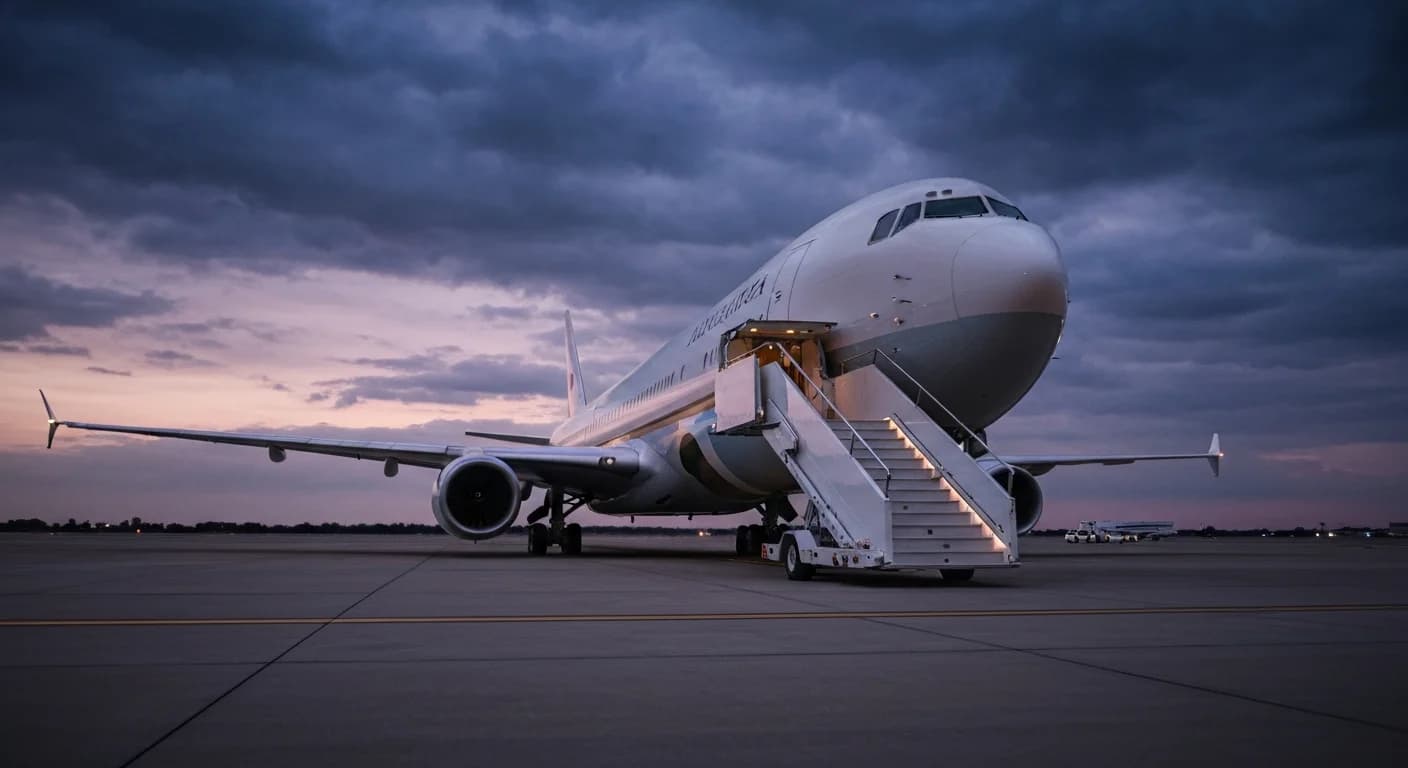
Nvidia CEO Jensen Huang boarded Air Force One Tuesday night after President Donald Trump personally called him and asked him to join the U.S. delegation to Beijing — a last-minute reversal of an exclusion that had been carefully engineered to avoid political fallout. Huang flew to Alaska to meet the aircraft, joining a CEO-heavy delegation hours before Trump landed for the first sitting-president visit to China in nearly a decade.
A Reversal Driven by Optics
According to Semafor, Huang had previously discussed with Trump that his presence in Beijing could invite unwanted scrutiny of the trip. Republican China hawks have sharply criticized Trump's decision to permit Nvidia to sell more advanced semiconductors to China, and Huang's attendance risked fueling intraparty tension that could distract from a broader reset of the U.S.-China relationship.
That calculus held until Tuesday morning, when Trump saw media coverage of Huang's absence. "Trump called Jensen this morning after seeing reports" about his exclusion and "told him he wanted him to come," Semafor reported. Hours later, Huang was airborne to Alaska. "Jensen is attending the summit at the invitation of President Trump to support America and the administration's goals," an Nvidia spokesperson said in a statement to CNBC.
Why Huang Wanted In
Nvidia's China market share has fallen from "90-some odd percent" to "zero" since U.S. export restrictions took hold, Huang said in late April. Nvidia has consistently argued that prolonged restrictions are counterproductive, potentially incentivizing China to accelerate domestic alternatives. With Huawei's Ascend line gaining ground and Chinese hyperscalers under government pressure to diversify away from U.S. silicon, every quarter of restricted access compresses Nvidia's runway in the world's second-largest compute market.
The H200 Question
The defining AI question for the summit is the H200 — Nvidia's advanced AI accelerator. The administration currently maintains strict limits on H200 sales to China, citing potential military applications and requiring third-party verification before shipments. Whether Trump uses the Beijing summit to loosen those limits, or trades them for concessions on rare earths, agriculture, or Taiwan, is the question Huang now has a seat at the table to influence.
Congress Is Watching
The political risk Trump initially sought to avoid hasn't gone away. House Foreign Affairs Chair Brian Mast captured the hawks' position bluntly: "The joke here is, Jensen wants us to trust the CCP." A House committee has already advanced legislation granting lawmakers 30-day review periods to block semiconductor sales to China and Iran — a procedural choke point that could outlast whatever Trump and Xi agree to this week.
Implications
For Nvidia, the optics of Air Force One are worth more than any single deal. For Trump, Huang's presence signals that AI chip policy will be negotiated face-to-face with Xi rather than left to the export-control bureaucracy. And for Beijing, it confirms that semiconductors — not soybeans or Boeings — are now the center of gravity in U.S.-China economic diplomacy.