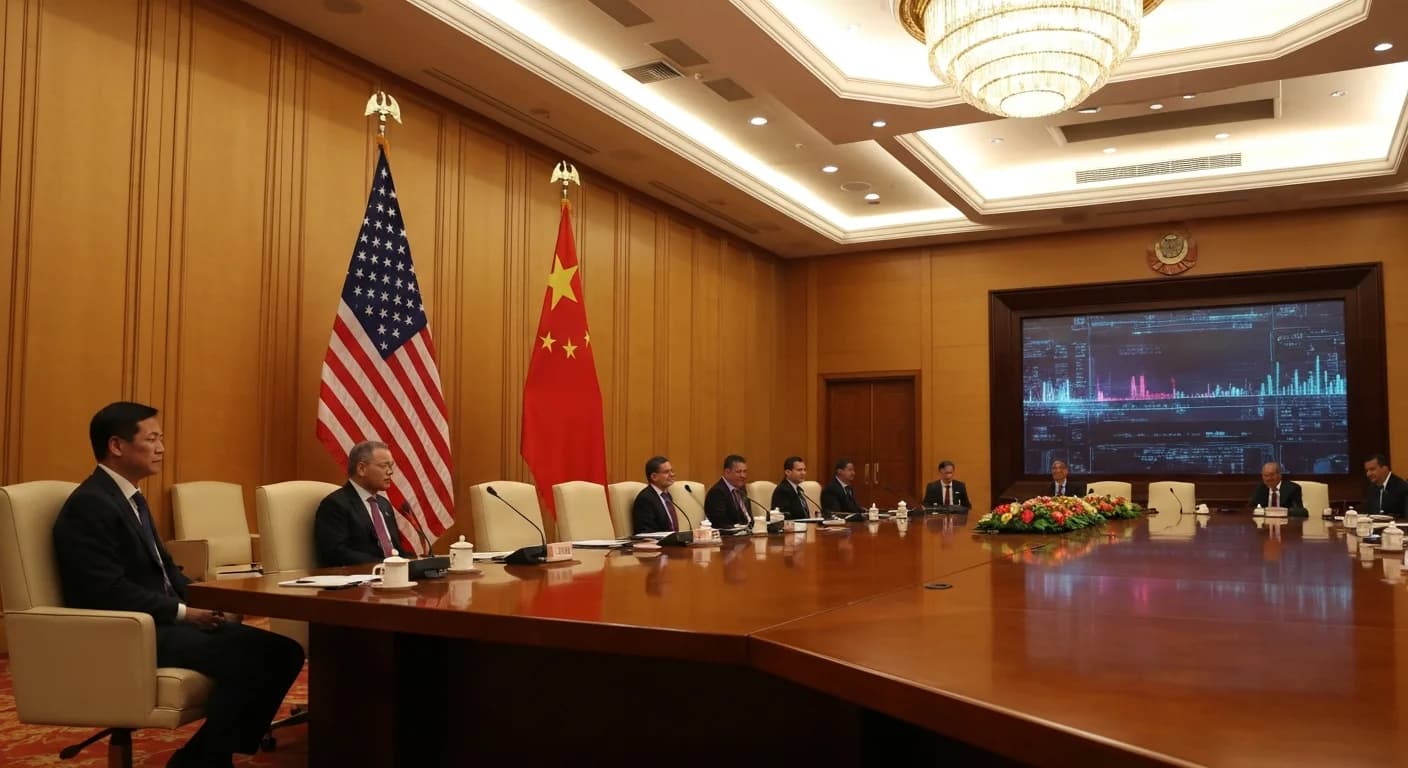
Treasury Secretary Scott Bessent told CNBC from the sidelines of the Trump–Xi summit in Beijing on May 14, 2026 that the United States and China will launch formal negotiations on a joint artificial intelligence safety protocol. The announcement marks the first time the two governments have publicly committed to a structured bilateral track on frontier AI risk, after months of escalating tension over export controls, model distillation accusations, and competing infrastructure buildouts.
What the protocol is supposed to do
Bessent framed the talks as a guardrails exercise rather than an arms-control deal. "The two AI superpowers are going to start talking," he said, adding: "We're gonna set up a protocol in terms of how do we go forward with best practices for AI to make sure non-state actors don't get a hold of these models." The stated goal is a shared framework of best practices and safeguards that prevents advanced models from leaking to terrorist groups, criminal networks, and other unaligned actors — a narrower remit than the broader capability-limits proposals that have circulated in Track II diplomacy.
He added that the administration's intent is to avoid heavy-handed rules, saying, "What we don't want to do is stifle innovation. So our responsibility is to come up with the highest performance calculus where we can get the most innovation and the highest level of safety."
Bessent's framing: leverage from being ahead
The Treasury Secretary tied the willingness to engage directly to US technical advantage. "The reason we are able to have fulsome discussions with the Chinese on AI is because we are in the lead," Bessent said. "I do not think we would be having the same discussions if they were this far ahead of us." He described maintaining that lead as "of utmost importance."
The posture is a notable break from the export-control-only stance that has dominated US policy on Chinese AI access since 2022, and a softer line than the recent White House memos accusing Chinese labs of running an "industrial-scale" distillation program against frontier US models.
Delegation includes Nvidia's Jensen Huang
Trump's delegation to Beijing included Nvidia CEO Jensen Huang alongside executives from Tesla, Apple, BlackRock, Boeing, and Qualcomm — a lineup heavy on companies with direct exposure to Chinese demand for AI hardware. Asked about Nvidia's H200 accelerators, which were cleared for sale to a small set of Chinese firms earlier this week, Bessent acknowledged "a lot of back and forth" but stopped short of confirming any finalized commercial agreement.
Why it matters
A bilateral US–China safety track, even a narrow one, would be the most significant piece of international AI governance machinery to emerge since the EU AI Act. The non-state-actor framing is the easiest common ground — both Beijing and Washington have reasons to keep the most capable models out of unaligned hands — and sidesteps the harder question of whether either government will accept constraints on its own military and intelligence use. The talks also arrive at a moment when Chinese labs including DeepSeek, Moonshot, and Alibaba's Qwen team are closing the capability gap on open-weight releases, making the "we are in the lead" framing harder to sustain over the lifetime of any protocol that gets signed.
No timeline, working group, or named negotiators were disclosed. Chinese officials have not yet issued a public response confirming the framework Bessent described.