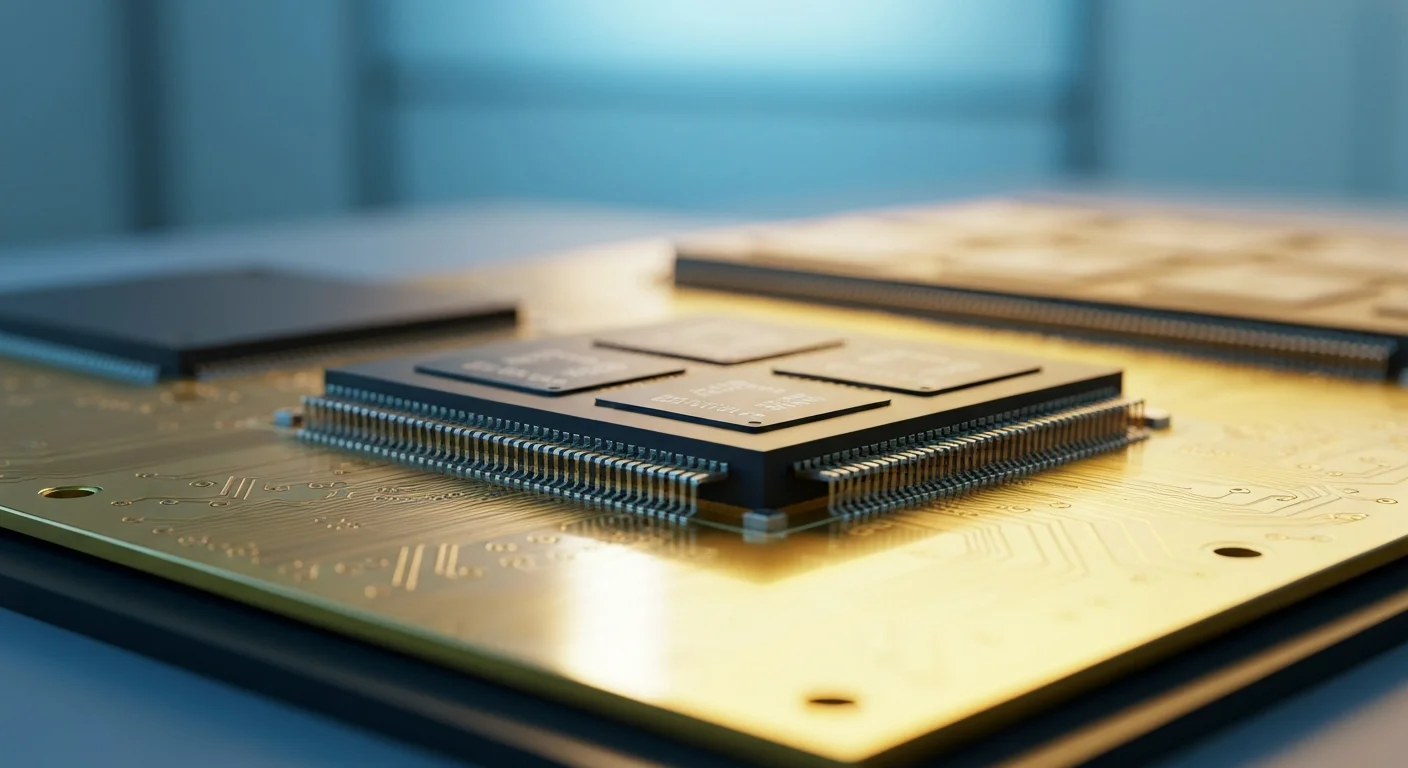
NASA's Jet Propulsion Laboratory said on May 15, 2026 that its next-generation High Performance Spaceflight Computing (HPSC) processor is hitting its performance targets in lab testing, a milestone that could finally bring meaningful onboard artificial intelligence to deep-space missions.
The chip, developed in partnership with Microchip Technology Inc. of Chandler, Arizona, is running at up to 100 times the computing power of current spaceflight computers, according to NASA. Against the radiation-hardened processors actually flying on today's probes and rovers, the gap is even larger — roughly 500 times the performance, the agency said.
A system-on-a-chip built for radiation
HPSC is a system-on-a-chip, meaning it integrates central processing units, computational offloads, networking, memory and input/output interfaces into one package. That density matters in space, where every gram and every watt is contested, and where today's flight computers tend to be slow, single-purpose and decades behind consumer silicon.
"Building on the legacy of previous space processors, this new multicore system is fault-tolerant, flexible, and extremely high-performing," Eugene Schwanbeck, the program element manager, said in NASA's announcement.
The processor has to do more than run fast. JPL engineers are subjecting prototype chips to radiation, thermal and shock tests intended to mimic the environment outside Earth's magnetosphere. "We are putting these new chips through the wringer by carrying out radiation, thermal, and shock tests while also evaluating their performance through a rigorous functional test campaign," said Jim Butler, the project manager at JPL.
Why this matters for AI in space
The headline capability is autonomy. With onboard AI, NASA says a spacecraft could respond to unexpected situations in real time when round-trip light delays — minutes to Mars, hours to the outer planets — make human control impractical. A lander could re-target during descent. An orbiter could decide which observations to keep when bandwidth back to Earth is scarce.
The chip is also designed to process, store and transmit large volumes of scientific data more efficiently, which has long been a bottleneck for deep-space science. Modern instruments can collect far more than current radios can downlink; better onboard processing means more of the raw stream can be triaged or compressed before it leaves the spacecraft.
Where it could fly
Once the processor is certified for use in space, NASA plans to integrate it into a wide variety of missions, including Earth orbiters, planetary rovers, deep space probes and crewed habitats. The agency is positioning HPSC as the common compute platform for the next wave of Moon and Mars exploration.
Implications
For years, the gap between consumer AI hardware and what actually flies on a spacecraft has been one of the quiet limits on planetary science. If HPSC clears qualification, it would put a credibly modern, AI-capable processor on NASA's parts list for the first time — and give mission designers permission to assume the spacecraft can think for itself a little longer between commands.