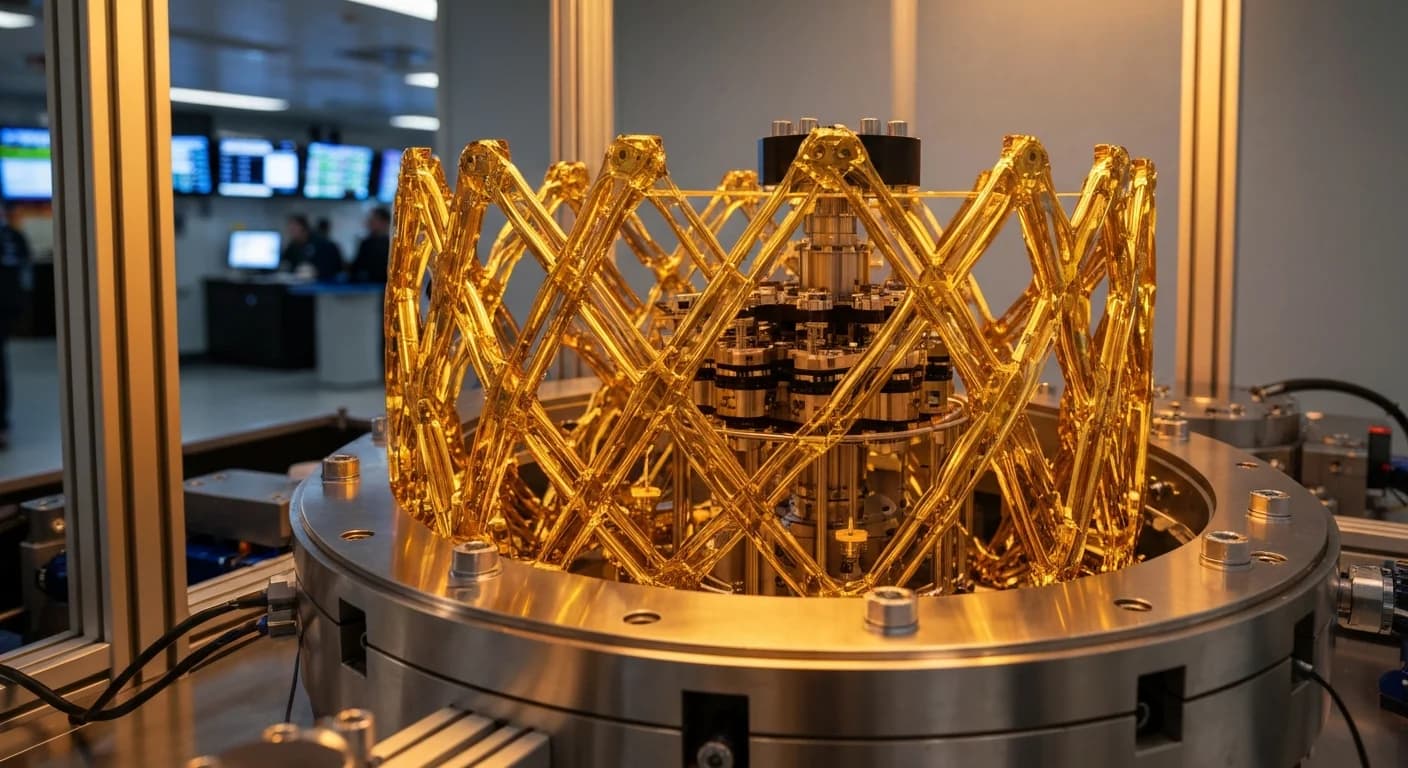
Quantinuum, the quantum computing company majority-owned by Honeywell, filed Tuesday to raise up to $1.05 billion in a Nasdaq IPO that would value it at roughly $12.7 billion — a marquee deep-tech listing arriving in the same capital window that has Cerebras, OpenAI, and SpaceX queued for the public markets.
The terms
Quantinuum is marketing about 21 million shares at $45 to $50 each, listing under the ticker QNT, with J.P. Morgan and Morgan Stanley as joint lead bookrunners. At the top of the range, the $12.7 billion target is a sharp step up from the $10 billion valuation set in a private round in September. Honeywell will retain roughly 49.1% of combined voting power after the offering and is expected to stay on as both a shareholder and a customer. The company, based in Broomfield, Colorado, was formed in 2021 by merging Honeywell Quantum Solutions with Cambridge Quantum, and is chaired by Honeywell CEO Vimal Kapur and run by Intel veteran Rajeeb Hazra.
The financials are the story
The valuation sits on a thin revenue base. Quantinuum reported $30.9 million in 2025 revenue against a $192.6 million net loss, up from $23 million in revenue and a $144.1 million loss in 2024. Per the filing, Q1 2026 revenue fell about 73% year over year to $5.2 million while the quarterly loss widened to roughly $136.6 million. At the top of the range, public investors would be underwriting a company trading near 400x trailing revenue — a bet on fault-tolerant trapped-ion hardware that is still years from commercial scale.
Washington's thumb on the scale
The listing follows the Commerce Department's announcement days earlier of $2 billion in letters of intent across nine quantum firms under the CHIPS and Science Act — deals in which the government takes a minority, non-controlling equity stake. Quantinuum is slated for about $100 million, alongside roughly $1 billion for IBM, $375 million for GlobalFoundries, and about $100 million each for D-Wave, Rigetti, and Infleqtion. It is the same equity-for-subsidy industrial-policy playbook Washington has run on chips and AI infrastructure, now extended to quantum and framed explicitly as a hedge against China.
What it signals for compute
Quantum is not displacing GPUs for AI training or inference any time soon, and Quantinuum's numbers make that clear. But QNT is a clean read on public-market appetite for pre-revenue frontier compute. A strong print de-risks the much larger AI-infrastructure IPO pipeline — Cerebras already priced above its range at a roughly $56 billion fully diluted valuation, with OpenAI's confidential filing and SpaceX/xAI behind it. A weak one tightens the window for every capital-hungry compute company betting that private valuations survive contact with public order books.