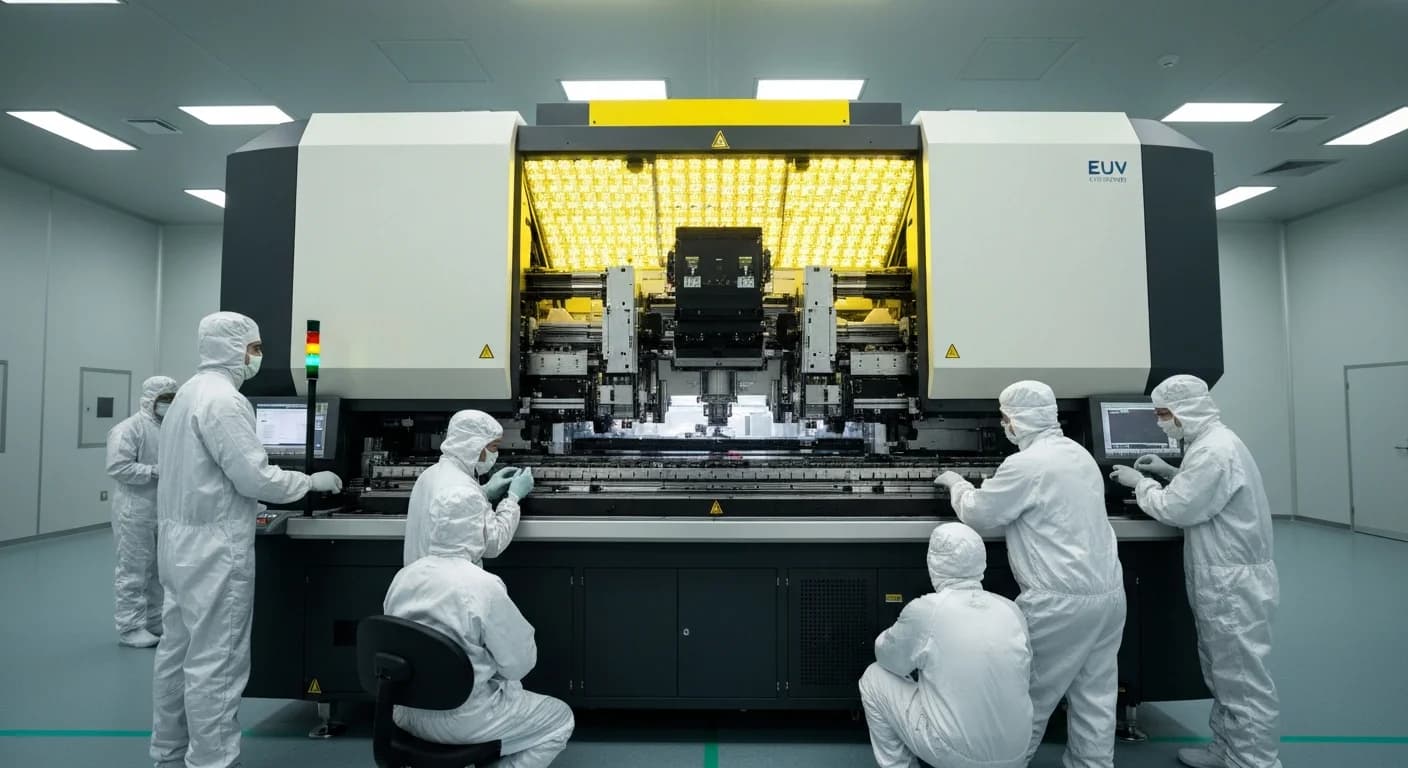
ASML, the world's sole manufacturer of extreme ultraviolet (EUV) lithography systems, reported first-quarter earnings on April 15 that topped analyst expectations, prompting the Dutch chipmaking equipment giant to raise its full-year revenue guidance amid relentless demand for AI semiconductors.
Q1 Results Beat Expectations
ASML posted Q1 revenue of €8.77 billion against a consensus estimate of €8.5 billion, while net income reached €2.76 billion — comfortably above the €2.54 billion analysts had forecast. Gross margins improved to 53%, up from 52.2% in the fourth quarter of 2025.
The company raised its full-year 2026 revenue guidance to €36–40 billion, up from the previous range of €34–39 billion, reflecting strengthening order pipelines from chipmakers racing to build out AI infrastructure.
"The semiconductor industry's growth outlook continues to solidify, driven by ongoing AI-related infrastructure investments," CEO Christophe Fouquet said. "Demand for chips is outpacing supply."
Memory Chips Lead the Surge
The most striking shift in ASML's Q1 results was the composition of its order book. Memory chips accounted for 51% of new tool sales, a dramatic jump from 30% in Q4 2025. The surge reflects aggressive capacity expansion by South Korean chipmakers Samsung and SK Hynix, which are racing to meet skyrocketing demand for high-bandwidth memory (HBM) used in AI accelerators.
South Korea represented 45% of Q1 sales, followed by Taiwan at 23% and China at 19% — the latter declining sharply from 36% in the previous quarter.
Export Controls Cloud the Horizon
Despite the strong results, ASML's Q2 revenue guidance of €8.4–9 billion came in below the €9.04 billion consensus, contributing to a roughly 5% decline in U.S. trading. The company acknowledged that its guidance range accommodates "potential outcomes of ongoing discussions around export controls," referencing proposed U.S. legislation under the MATCH Act that would restrict sales of deep ultraviolet lithography machines to China.
China's share of ASML revenue has already been declining amid tightening restrictions, but a full DUV ban would represent a material headwind.
What It Means for AI
ASML's results serve as a bellwether for the broader AI hardware supply chain. With each EUV machine costing hundreds of millions of euros and lead times stretching over a year, Fouquet noted that "customers are accelerating expansion plans well beyond the near term."
The company executed €1.1 billion in share buybacks during the quarter and holds €8.38 billion in cash, positioning it to continue scaling production. CFO Roger Dassen set the 2026 shipment target for low-NA EUV machines at 60 units — roughly 25% above 2025 volumes — with capacity to reach at least 80 units the following year.
As AI infrastructure spending shows no signs of slowing, ASML remains the indispensable bottleneck through which the entire semiconductor industry must pass.