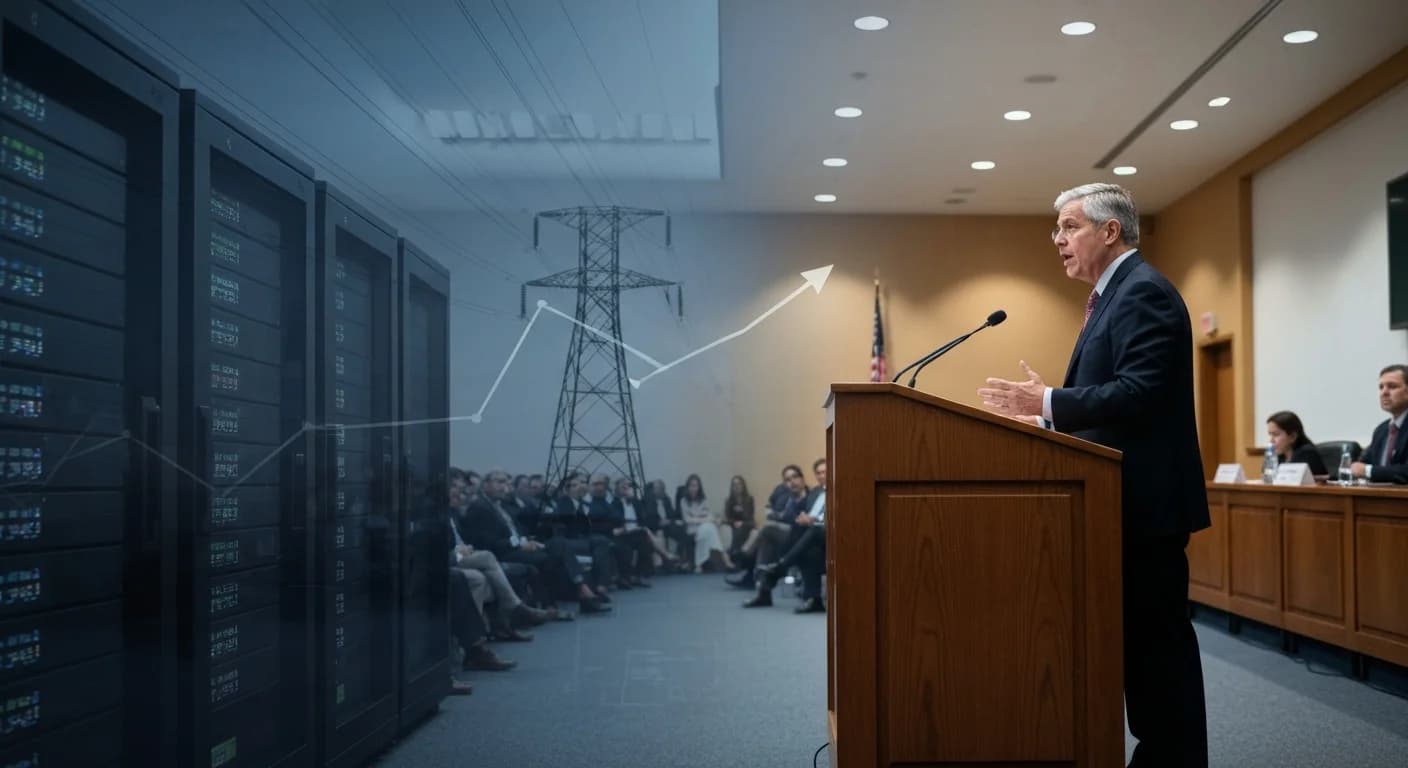
Federal Reserve Governor Lisa D. Cook put a hard number on the AI capital cycle that treasury and infrastructure teams should be watching: in a May 27 address at the Stanford Institute for Economic Policy Research, she noted companies have announced "more than $1.5 trillion in data-center plans, only a small portion of which have been realized." The speech, titled "The Opportunities and Risks AI Presents for the Economy and Financial System," reframed the buildout from a growth story into a financial-stability variable the central bank is now actively tracking.
The gap between announced and built
The $1.5 trillion figure matters precisely because most of it is unrealized — a pipeline large enough to move prices for chips, equipment, and power before the racks are even installed. Cook tied that demand to broader inflation pressure: the PCE price index rose 3.8 percent over the 12 months ending in April, and core PCE is estimated at 3.3 percent, "its highest reading since 2023." She singled out resource costs, noting "electricity and water prices have each increased by about 5 percent over the past year" — a direct input to data-center operating economics.
Where the Fed sees fragility
Cook's financial-stability concerns clustered around how the buildout is financed and how AI is being deployed in markets. "Many of the hyperscaler firms have executed large investment-grade bond deals in recent months to fund AI capital expenditures," she said, while a "wave of redemptions" has "put significant pressure on both traded and nontraded perpetual business development companies" — the private-credit channel that increasingly backstops AI infrastructure and software borrowers.
On markets, she warned that AI-driven algorithmic trading "may generate financial-stability risks, such as more correlated trading, endogenous model collusion, potential market manipulation, and greater market concentration." The phrase to underline for quant and risk teams is endogenous model collusion: independently trained systems converging on correlated behavior without explicit coordination. Cook tempered the leverage worry, judging it "unlikely to return to peak leverage levels observed before the Global Financial Crisis."
What it changes for builders and enterprise
Two signals land hardest. First, on labor: Cook cautioned that "AI-related job loss could precede job gains," adding there is no conclusive evidence of this yet but that "it may still be on the horizon." Second, on financing: she backed holding rates steady but stayed hawkish, saying she is "prepared to raise rates" if expected disinflation fails to appear — meaning the cost of capital underwriting the compute boom is not easing on the Fed's account.
Notably, Cook stressed the FOMC "is not using AI in developing or setting policy," even as other Fed divisions deploy it for network-risk identification and scenario analysis that would otherwise be "prohibitively time-consuming." For enterprise AI buyers and infra operators, the takeaway is structural: the central bank now treats debt-funded data-center capex, private-credit exposure, and model-driven trading correlation as systemic inputs — and rates won't drop to subsidize the buildout.