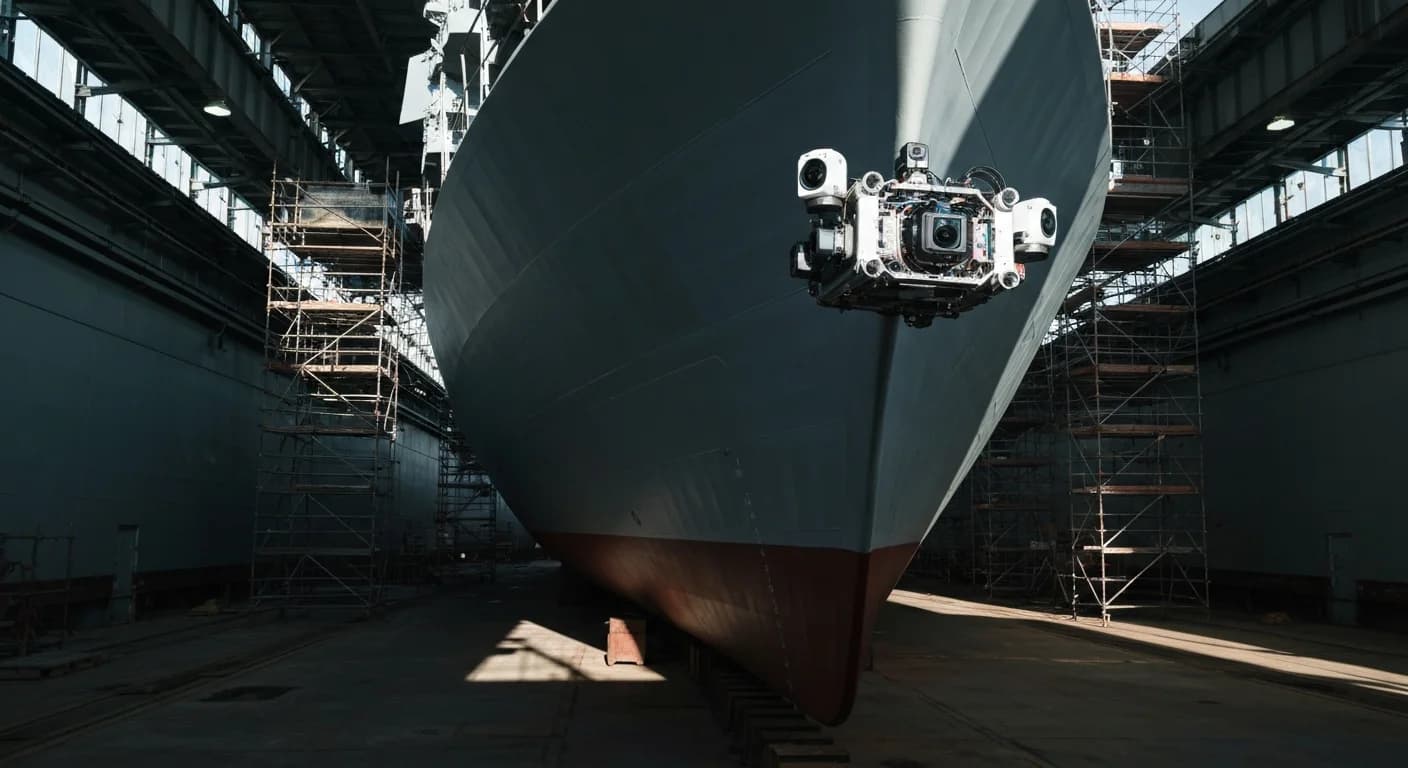
The U.S. Navy has awarded Pittsburgh-based Gecko Robotics a contract worth up to $71 million to deploy AI-powered robots across its Pacific Fleet — the largest robotics deal in Navy history. The five-year indefinite delivery, indefinite quantity (IDIQ) agreement, signed with the U.S. General Services Administration, starts with an initial $54 million award.
Robots That Climb, Fly, and Swim
Gecko's fleet of robots is designed for environments that are dangerous, cramped, or simply impractical for human inspectors. The machines can climb ship hulls, fly through interior compartments, and even operate underwater. Equipped with cameras, sensors, and AI-driven analysis software, they condense inspection processes that traditionally take three months down to as little as two days.
The company says its technology identifies repairs up to 50 times faster and more accurately than manual methods — a claim that clearly resonated with Navy leadership.
Starting With 18 Ships
The initial deployment targets 18 vessels in the U.S. Pacific Fleet, spanning destroyers, amphibious warships, and littoral combat ships. The Pacific Fleet is the Navy's largest, and its readiness is a top strategic priority given rising tensions in the Indo-Pacific region.
Currently, about 40 percent of the Navy's fleet is unavailable at any given time due to lengthy maintenance cycles. The Navy has set an ambitious target of 80 percent ship readiness by 2027, and Gecko's technology is positioned as a key tool for closing that gap.
From Industrial Roots to Defense
Gecko Robotics was founded in 2016 and initially focused on inspecting industrial infrastructure like power plants and storage tanks. The pivot to defense has accelerated in recent years, and this contract represents a major validation of its platform in a military context.
The deal also reflects a broader trend of the U.S. Department of Defense embracing AI and robotics to modernize legacy maintenance processes. Rather than replacing human workers, the robots serve as a force multiplier — giving maintenance crews detailed, AI-analyzed data about exactly where problems exist before a single wrench is turned.
Implications for Defense AI
The contract is notable not just for its size but for what it signals about the Pentagon's willingness to trust AI systems with critical fleet operations. As autonomous inspection tools prove their value in maintenance, the door opens to broader adoption across other military branches and infrastructure types.
For the AI defense sector, Gecko's win sets a benchmark. It demonstrates that startups with proven industrial AI platforms can compete for — and win — significant government contracts that were once the exclusive domain of traditional defense contractors.