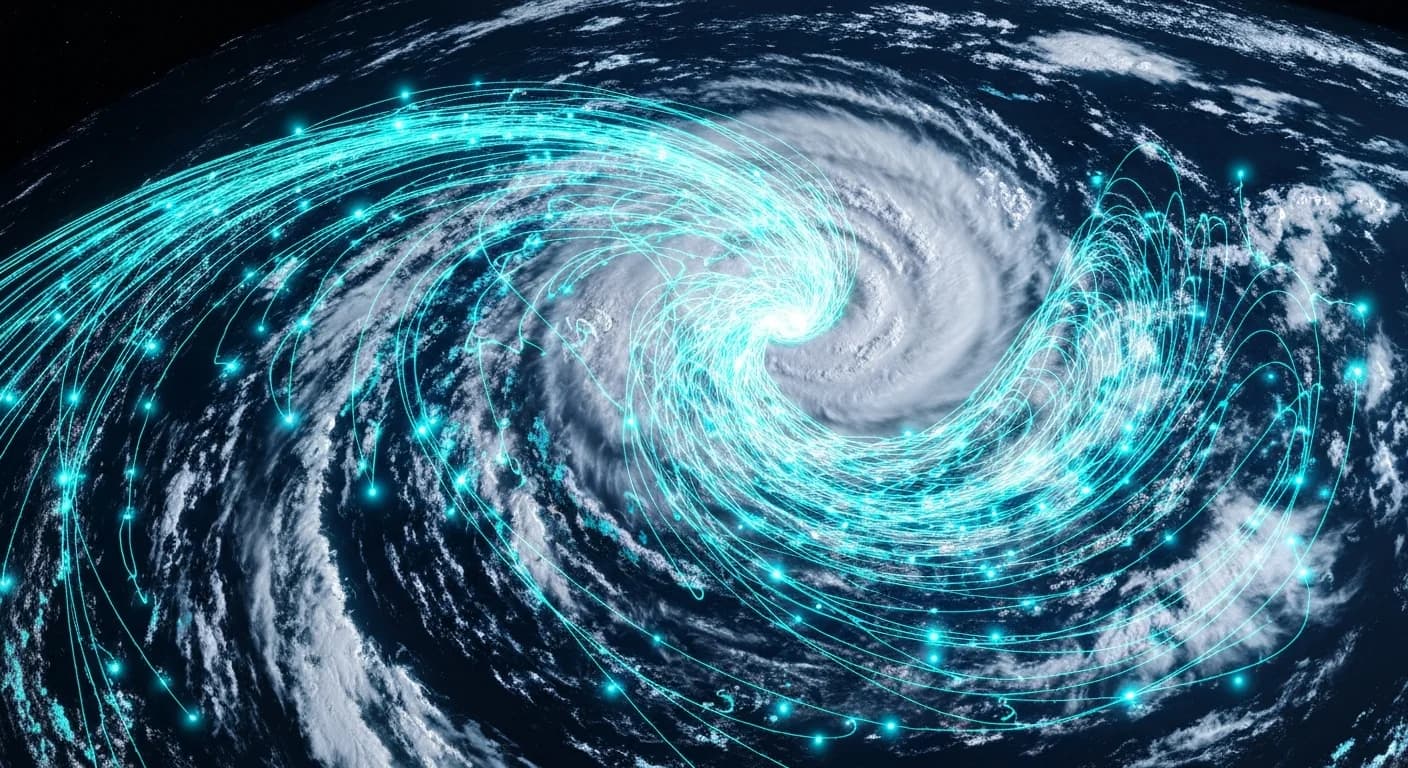
Google DeepMind has released a major upgrade to GenCast, its AI weather prediction model, adding specialized tropical cyclone tracking that predicts hurricane paths 10 days out with 95% accuracy on historical test data. NOAA announced it will integrate GenCast into its operational hurricane forecasting pipeline starting with the 2026 Atlantic season.
What Changed
The original GenCast, published in Nature in late 2024, already outperformed the European Centre for Medium-Range Weather Forecasts (ECMWF) ensemble system on general weather prediction. The new version adds a specialized module trained on 40 years of tropical cyclone data from the International Best Track Archive.
In blind tests against the 2024 and 2025 hurricane seasons, GenCast predicted Category 3+ hurricane landfall locations within 50 miles at 10-day lead time — a 35% improvement over ECMWF's ensemble forecasts at the same range.
Why It Matters
Hurricane path forecasting has improved roughly one day per decade since the 1990s. GenCast's upgrade represents a leap equivalent to 15 years of incremental progress delivered in a single model update.
The practical impact is enormous. Every additional day of accurate warning saves an estimated $1.5 billion in evacuation costs and property protection across the U.S. Gulf Coast. At 10-day accuracy, GenCast could give emergency managers nearly a week more of reliable planning time than current operational models.
NOAA Adopts GenCast
NOAA's National Hurricane Center confirmed it will run GenCast alongside its existing models — the Global Forecast System (GFS) and the Hurricane Weather Research and Forecasting system (HWRF) — starting June 1, 2026.
"We're not replacing our operational models," said NOAA spokesperson Dr. Maria Torres. "We're adding GenCast as a high-weight member of our ensemble guidance. The skill improvement on track forecasting is too significant to ignore."
GenCast will run on Google Cloud TPU infrastructure under a zero-cost research agreement with NOAA, generating 50-member ensemble forecasts in under 8 minutes — compared to the hours required for traditional numerical weather prediction runs.
The Broader Pattern
GenCast joins a growing wave of AI weather models reshaping meteorology. Huawei's Pangu-Weather, NVIDIA's FourCastNet, and Microsoft's Aurora have all demonstrated competitive performance against physics-based models. But GenCast's hurricane-specific accuracy sets a new high-water mark for safety-critical weather prediction.
DeepMind has open-sourced the model weights and training code, making it available for any national weather service to adopt and fine-tune for regional conditions.