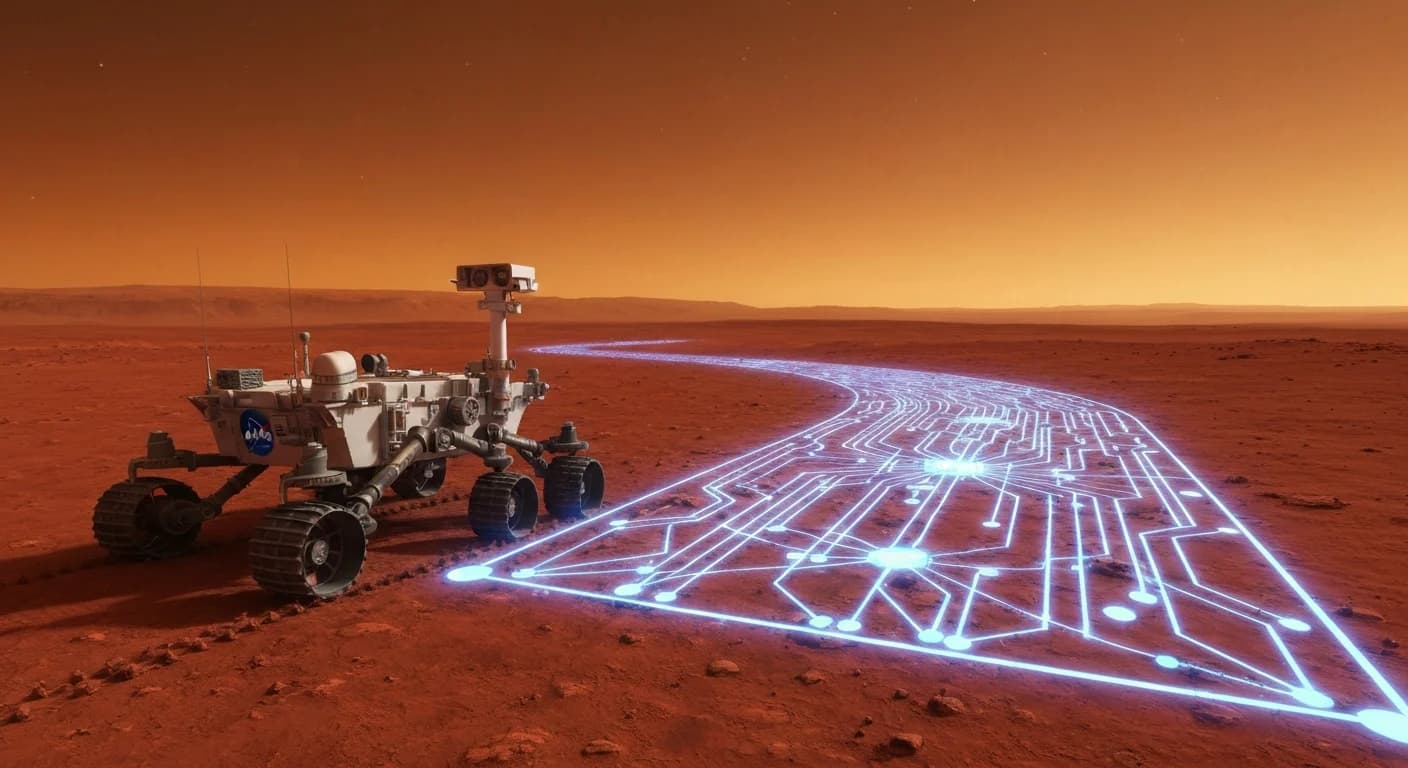
NASA's Perseverance rover has made history by completing the first drives on another planet that were planned entirely by artificial intelligence. The two demonstration drives, executed on December 8 and 10 and announced by JPL in late January, represent a fundamental shift in how humanity operates robots on other worlds.
How It Works
Traditionally, planning a Mars rover drive is a painstaking human process. A team at JPL's Rover Operations Center manually reviews terrain images, identifies hazards, plots waypoints, and uploads commands — a process that can take an entire day for a single drive sequence.
The new system uses generative AI to perform that entire planning task. The AI analyzes terrain imagery from the rover's cameras, generates optimal waypoints, and produces drive commands — work that previously required a team of specialists.
The technology was developed in collaboration with Anthropic, using Claude models adapted for spatial reasoning and mission-critical decision-making.
The Drives
On December 8, Perseverance drove 689 feet (210 meters) using AI-generated waypoints. Two days later, it covered 807 feet (246 meters) — a combined 1,496 feet of fully AI-planned autonomous navigation on Mars.
Before any commands reached the rover, JPL engineers verified them against a digital twin — a complete virtual replica of Perseverance and its environment. The verification process checked over 500,000 telemetry variables to confirm the AI's instructions were safe and compatible with the rover's flight software.
Why It Matters
Mars is far enough from Earth that radio signals take 4 to 24 minutes each way. That communication delay means real-time remote control is impossible. Every minute the rover spends waiting for human-planned commands is a minute it is not doing science.
AI-planned drives could dramatically increase the rover's daily range and productivity. Instead of one carefully planned drive per sol (Martian day), the rover could execute multiple drives with AI handling the route planning in near real-time.
Beyond Navigation
JPL has also developed a separate system called Mars Global Localization that lets Perseverance determine its precise location without GPS — which does not exist on Mars — using generative AI to match camera images against orbital maps.
Together, these capabilities point toward a future where Mars rovers and eventually crewed missions rely on AI for routine navigation, freeing human operators to focus on scientific decisions rather than driving logistics.
The Bigger Picture
The Perseverance demonstration is the most consequential real-world deployment of generative AI outside of a data center. It proves that these models can handle safety-critical, high-stakes decision-making in environments where failure is not an option and human oversight has a 20-minute lag.
If AI can navigate Mars, the argument for AI-assisted decision-making in terrestrial applications — autonomous vehicles, disaster response, infrastructure inspection — gets considerably stronger.