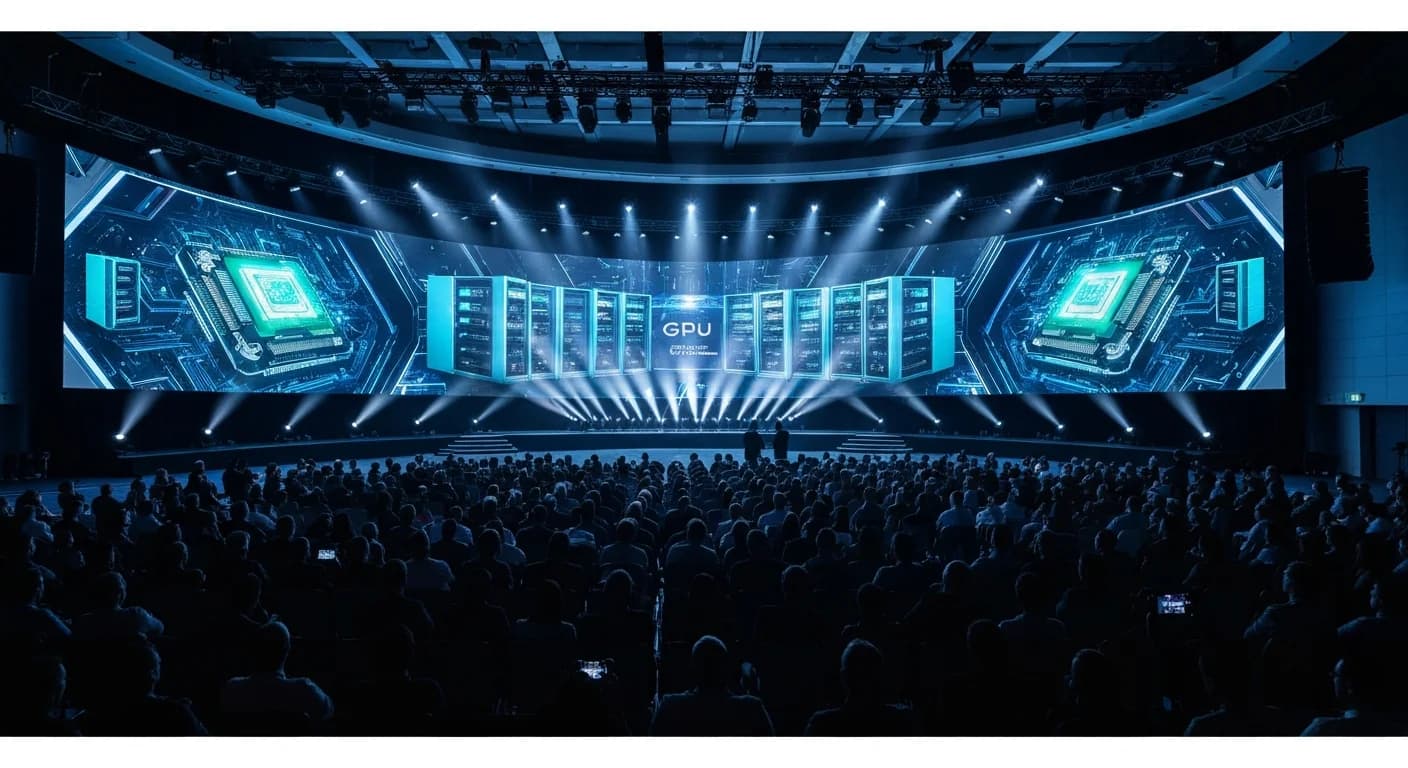
NVIDIA CEO Jensen Huang took the stage at GTC 2026 in San Jose on March 16 with a staggering projection: combined purchase orders for the company's Blackwell and Vera Rubin AI chip platforms will reach $1 trillion through 2027. The figure doubles NVIDIA's previous forecast of $500 billion and underscores the accelerating appetite for AI infrastructure among hyperscalers, enterprises, and sovereign cloud providers.
A Trillion-Dollar Runway
The revised projection reflects demand that NVIDIA says is being driven by a fundamental shift toward agentic AI workloads. Major cloud providers are scaling up aggressively — AWS announced it will deploy more than one million NVIDIA GPUs, while Microsoft became the first hyperscaler to validate Vera Rubin NVL72 systems and separately deployed liquid-cooled Grace Blackwell GPUs at scale.
Pharmaceutical giant Roche disclosed that it has deployed over 3,500 Blackwell GPUs across its global operations for drug discovery and manufacturing, signaling that enterprise demand extends well beyond the tech sector.
Kyber: The Next Leap in Rack Design
Beyond near-term revenue, Huang offered a glimpse of NVIDIA's longer-term hardware roadmap. The Kyber architecture, shown in prototype form, rethinks rack design from the ground up. Instead of horizontal compute trays, Kyber arranges 144 GPU packages vertically in a fully liquid-cooled, fanless enclosure, significantly boosting density and lowering inter-GPU latency.
Kyber will debut as part of the Vera Rubin Ultra platform, with each rack housing 144 GPU packages containing 4 chiplets each for a total of 576 GPU chiplets per rack. The architecture will eventually scale to an NVL1152 supercomputer configuration using direct optical interconnects between racks, laying the foundation for what NVIDIA calls the Feynman era of extreme-scale AI computing.
Autonomous Driving Momentum
GTC 2026 also brought significant news for the autonomous vehicle industry. BYD, Nissan, Geely, Isuzu, and Hyundai are all adopting NVIDIA's Drive Hyperion platform to develop Level 4 autonomous vehicles. Hyundai's implementation will span from Level 2 driver-assist all the way to Level 4 full autonomy, using a unified architecture.
NVIDIA also confirmed that its full-stack robotaxi systems will launch with Uber across 28 markets by 2028, starting in Los Angeles and San Francisco in the first half of 2027.
Implications for the Industry
The trillion-dollar pipeline figure sets a new benchmark for the AI hardware market and may intensify competition from AMD, Intel, and custom silicon efforts at major cloud providers. For a closer look at the inference-focused Groq LPU reveal and Kyber's per-watt gains, see our deep dive on NVIDIA's inference pivot. For enterprises evaluating AI infrastructure investments, GTC 2026 delivered a clear message: the buildout is accelerating, not plateauing, and NVIDIA intends to remain at the center of it.