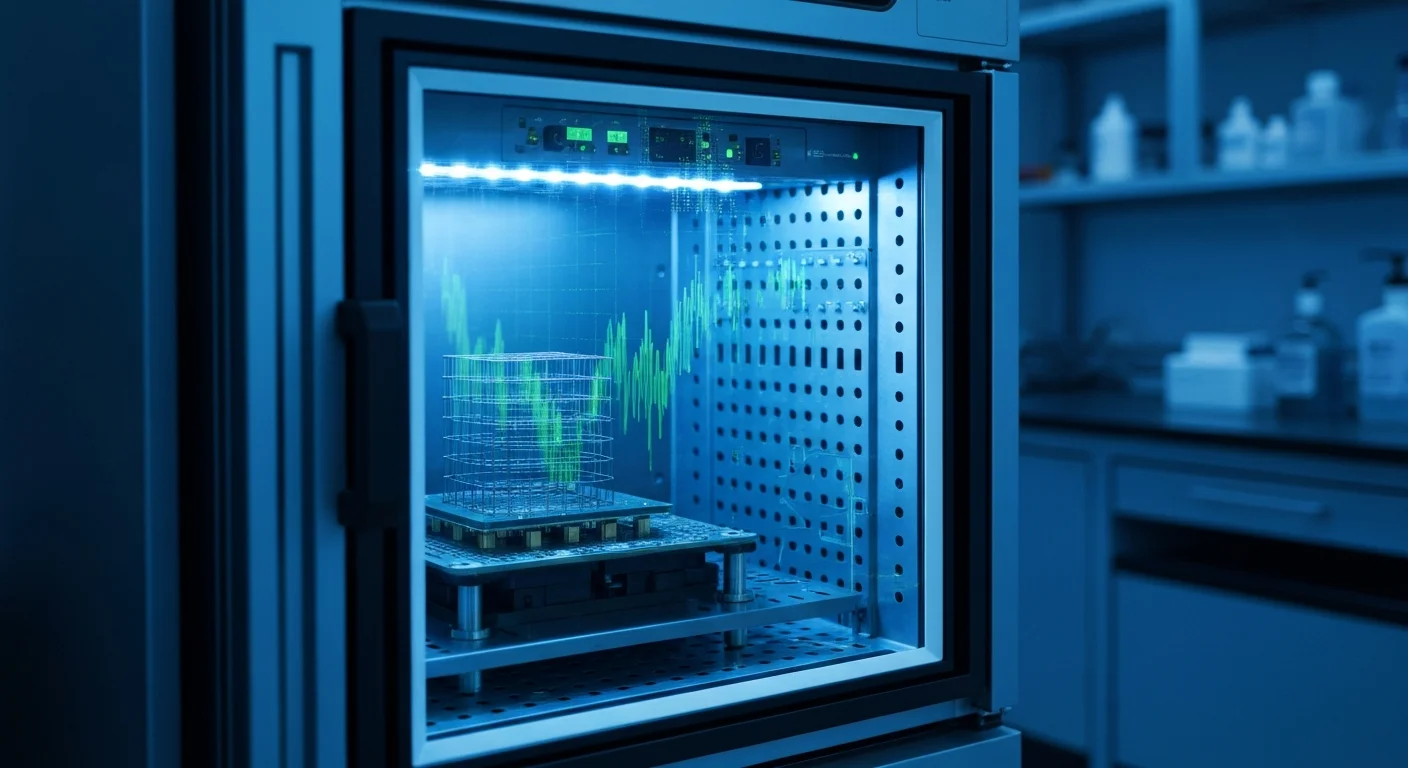
NVIDIA today launched Ising, which it describes as the world's first family of open-source AI models purpose-built for quantum computing. Unveiled on World Quantum Day on April 14, 2026, the release pushes the company's bet that classical AI — not just exotic physics — is the missing ingredient standing between today's noisy quantum prototypes and genuinely useful quantum machines.
"AI is essential to making quantum computing practical," said NVIDIA CEO Jensen Huang in the announcement. "With Ising, AI becomes the control plane — the operating system of quantum machines."
What Ising actually does
The Ising family ships with two components aimed at the two most painful bottlenecks in running a quantum processor.
Ising Calibration is a vision language model that reads instrument data coming off a quantum processor and autonomously tunes it. Calibration is typically a slow, hand-crafted ritual where scientists nudge qubits into usable states over days of trial and error. NVIDIA says Ising Calibration collapses that cycle from days to hours by letting AI agents run continuous automated calibration loops.
Ising Decoding tackles quantum error correction — the problem of figuring out, in real time, which of your fragile qubits just flipped. It uses two variants of a 3D convolutional neural network, tuned for either speed or accuracy. According to NVIDIA's benchmarks, the decoders run up to 2.5x faster and 3x more accurately than pyMatching, the open-source decoder most research groups rely on today.
A broad coalition of early adopters
Rather than gating the models behind a partner program, NVIDIA is releasing Ising as open source and has lined up an unusually wide set of launch users. Named adopters include quantum hardware companies IonQ, IQM Quantum Computers, Infleqtion, Atom Computing, Q-CTRL, EeroQ and Conductor Quantum, alongside national labs such as Fermi National Accelerator Laboratory, Lawrence Berkeley National Laboratory's Advanced Quantum Testbed and the UK National Physical Laboratory. Academic groups at Harvard, Cornell, UC San Diego, UC Santa Barbara, the University of Chicago, USC, Academia Sinica and Yonsei are also on board.
Why it matters
NVIDIA's pitch for years has been that GPUs and classical AI are the scaffolding on which any useful quantum computer will eventually stand. Ising is the clearest embodiment of that thesis yet: rather than selling quantum hardware, NVIDIA is offering to run the messy classical layer around someone else's qubits. If the calibration and decoding speedups hold up outside NVIDIA's benchmarks, the company will have positioned itself as the default control-plane vendor for the nascent quantum industry — the same strategic move that made CUDA inescapable in AI.
The broader implication is that "Q-Day," the long-promised moment when quantum machines start solving real-world problems, increasingly depends on classical AI catching up to the noise. With Ising now open and free, that race just got a lot more interesting.


