Nvidia reported a record $81.6 billion in fiscal first-quarter revenue — up 85% year over year and 20% sequentially — and the stock fell anyway. Shares slipped nearly 2% in the session after the May 20 report, the fourth consecutive quarter Nvidia has declined following a beat-and-raise. For a company whose results still define the AI infrastructure cycle, the disconnect between fundamentals and price is now the story.
The numbers were not the problem
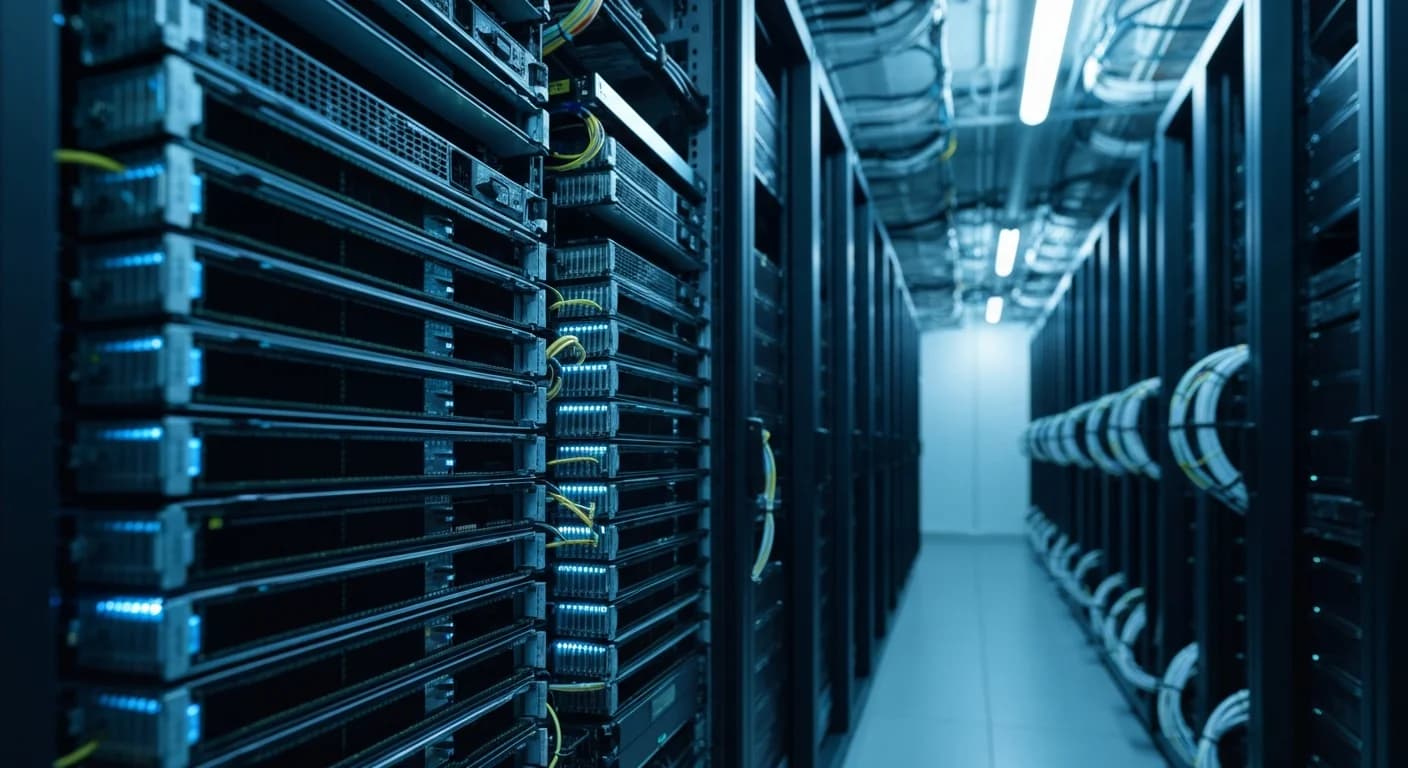
Data center revenue reached $75.2 billion, up 92% year over year, with data center networking alone at $14.8 billion — up 199%, evidence that the buildout is increasingly about rack-scale interconnect, not just GPUs. Non-GAAP EPS rose 140%, gross margin held at 75%, and free cash flow set a record at $48.6 billion. Management guided Q2 to roughly $91 billion (±2%), implying ~95% annual growth, raised the dividend 25-fold to $0.25 per share, and authorized an additional $80 billion buyback. "Demand has gone parabolic," CEO Jensen Huang said, adding that "tokens are now profitable, so model makers are in a race to produce more." The company also reaffirmed confidence in roughly $1 trillion of cumulative Blackwell and Rubin revenue through 2027.
What the market is actually pricing
Three concerns override the headline beat. First, competition from hyperscaler silicon: recent results from Google and Amazon signaled that internal accelerators — TPU and Trainium — are absorbing a growing share of training and inference workloads that once defaulted to Nvidia. Second, China: Nvidia reportedly has not shipped H200 parts despite permits, while Beijing pushes domestic substitution, clouding a market that once contributed meaningful revenue. Third, valuation and oversupply: analysts have flagged potential data center power and cooling oversupply in late 2026 and 2027, and the stock's multiple leaves little room for deceleration.
The relative performance underlines it. Nvidia is up roughly 19% year to date — about double the S&P 500's ~8.6% — yet the Philadelphia Semiconductor Index has climbed 60%, leaving Nvidia among the worst performers of the benchmark's 30 constituents. Capital is rotating toward memory, networking, and power names rather than the GPU incumbent.
What changes for builders
For infrastructure teams, the signal is structural, not bearish. Nvidia's order book remains the tightest constraint in the stack, but the rise of credible second sources changes procurement math: multi-silicon strategies, framework portability, and committed-capacity negotiations now carry leverage they lacked a year ago. Enterprises planning 2027 training runs should price in real optionality across TPU, Trainium, and merchant GPUs — and watch whether networking and HBM, not raw FLOPs, become the gating line item. The fundamentals say the buildout is accelerating; the tape says the easy money in owning the obvious winner is over.