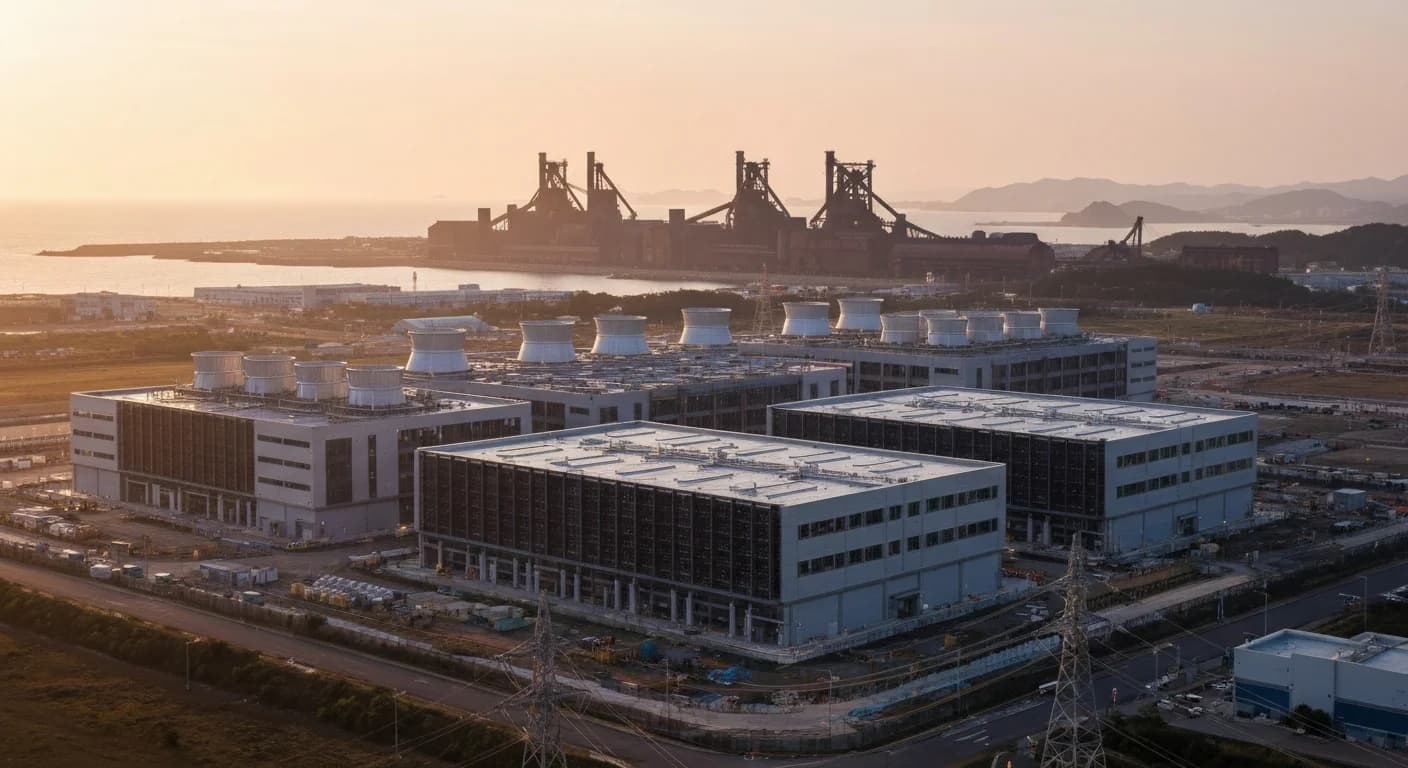
South Korea's former steel capital is pivoting hard into AI compute. Pohang's project vehicle has approved a 550 billion won (~$370 million) AI data center sized for 20,000 high-performance GPUs, with 50% of Phase 1 capacity already pre-leased to a major domestic cloud operator. Commercial operations are scheduled for October 2027.
Phase 1: 40MW, 100,000 Square Meters, Hyundai As Builder
The initial facility will sit on a 100,000 square meter parcel inside the Gwangmyeong General Industrial Complex in Nam-gu, Pohang. Forest Partners is leading the equity stack with a 120 billion won commitment, joined by Korea's Regional Revitalization Investment Fund and the National Growth Fund. Hyundai Engineering & Construction has been named preferred bidder for construction.
The 50% anchor pre-commitment is the structurally interesting part. AI data center developers globally are struggling to underwrite speculative builds without named demand; Pohang is breaking ground with half its rack capacity already spoken for.
Power Is the Real Asset
The siting logic leans on legacy steel infrastructure. Pohang already has substation capacity originally specified for POSCO mill operations, which removes one of the longest-lead bottlenecks for any new hyperscale build. The Wolseong nuclear power plant sits 38km away in Gyeongju — comfortably inside the ~50km radius that hyperscalers treat as the practical limit for latency- and resilience-sensitive AI workloads.
Kim Cheol-seung, CEO of the AI Factory Pohang PFV special-purpose vehicle, summarized the pitch: "Pohang has ample power reserves originally secured for steel mill operations." That framing matters because power, not silicon, is the binding constraint for most non-capital-region Korean projects.
Phase 2: 260MW and a Global Tenant Hunt
North Gyeongsang Province and Pohang City are pursuing a 260MW Phase 2 with an estimated 2 trillion won price tag. Groundbreaking is targeted for the first half of 2027, with demand commitments from global Big Tech being courted in the second half of 2026. Combined, the two phases would produce roughly 300MW of AI compute capacity in a single cluster — the largest in Korea by current commitments.
What Changes for Builders
Pohang's timeline puts it more than two years ahead of competing non-Seoul Korean projects, and the anchor-pre-lease model gives equity investors a credibility template that other Asian secondary cities will likely copy. For enterprise teams routing inference or training to Asia, the calculus is shifting: capacity outside the saturated Seoul and Tokyo metros, with power-adjacent siting, becomes a real procurement option from late 2027.
The broader signal is that ex-industrial cities with stranded grid capacity are emerging as the next tier of AI infrastructure markets — and demand commitments are arriving before the concrete is poured.