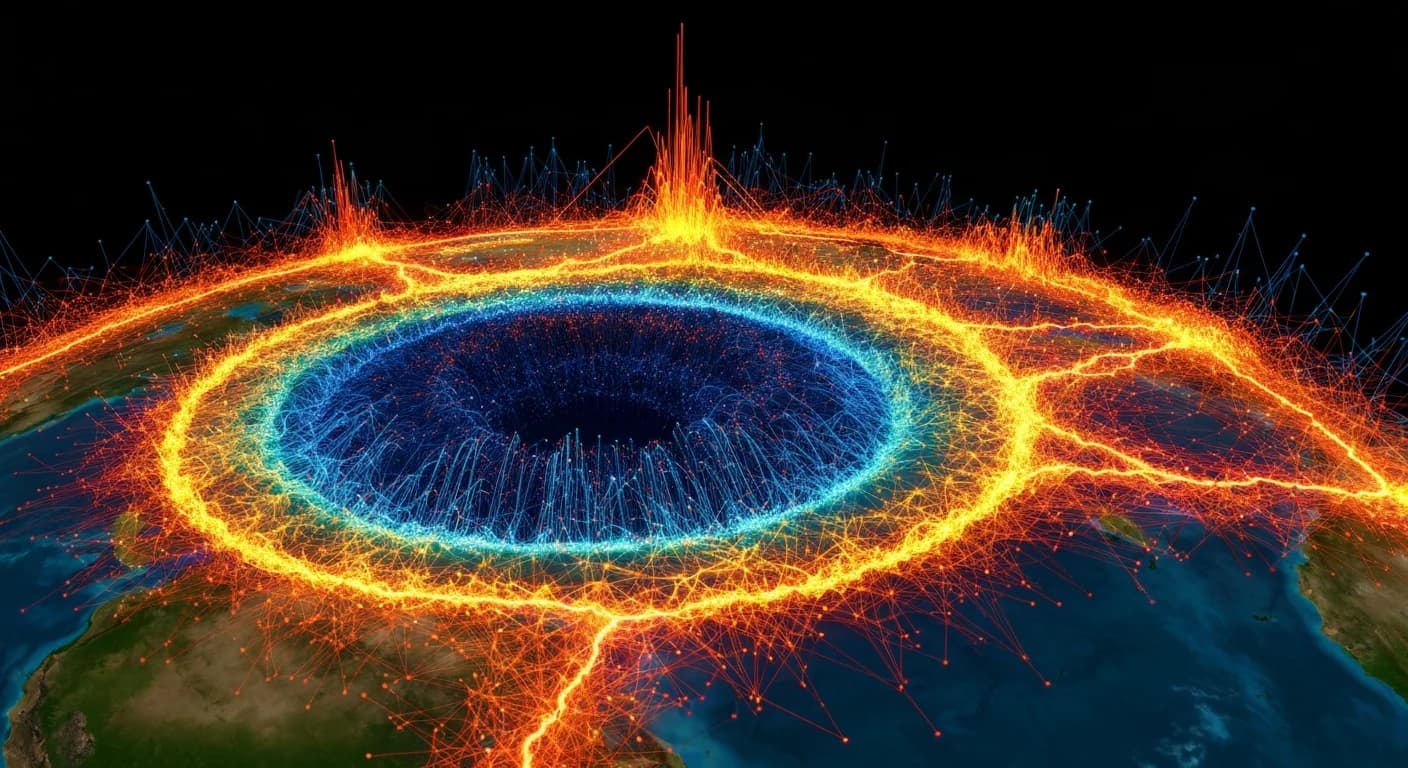
Stanford researchers have developed an AI model called SeismoNet that predicts where earthquake aftershocks will occur with 85% accuracy. The result represents a dramatic improvement over traditional Coulomb stress failure models, which achieve roughly 6% accuracy on the same task. The U.S. Geological Survey has announced a pilot program to integrate the system into its monitoring operations for the Pacific Northwest.
How SeismoNet Works
The model was trained on 130,000 earthquake sequences drawn from global seismological databases, including the International Seismological Centre catalog, the USGS Advanced National Seismic System, and Japan's National Research Institute for Earth Science and Disaster Resilience.
Rather than relying on the physics-based Coulomb stress transfer calculations that have dominated seismology for decades, SeismoNet uses a graph neural network to learn spatial relationships between fault structures. The model takes as input the mainshock's location, depth, magnitude, and focal mechanism, along with mapped fault geometries within a 100-kilometer radius, and outputs a probability distribution of aftershock locations.
The team validated the model on earthquake sequences from 2024 and 2025 that were excluded from training data. Across 412 held-out sequences, SeismoNet correctly identified the aftershock zone in 85% of cases, compared to 6% for Coulomb models and 19% for the previous best machine learning approach.
Why Traditional Models Fail
Coulomb stress models calculate how a mainshock redistributes stress on surrounding faults and predict that aftershocks will occur where stress increases. In theory, this is physically sound. In practice, the calculations require precise knowledge of fault orientations, friction coefficients, and regional stress fields — data that is rarely available at sufficient resolution.
SeismoNet sidesteps this problem by learning directly from observed aftershock patterns rather than attempting to model the underlying physics from incomplete data.
USGS Pilot Program
USGS director David Applegate confirmed that the agency will begin a pilot integration of SeismoNet for the Cascadia Subduction Zone and surrounding fault systems in the Pacific Northwest. The region faces significant seismic risk, including the potential for a magnitude 9.0 event on the Cascadia megathrust.
The pilot will run SeismoNet alongside existing forecasting tools rather than replacing them. USGS seismologists will evaluate the model's real-time performance against actual aftershock sequences over a 12-month period beginning in late 2026.
Limitations and Next Steps
SeismoNet does not predict when aftershocks will occur or their magnitudes — only their likely locations. The model also performs less reliably in regions with sparse historical seismicity data, such as parts of the central United States and continental interiors where major earthquakes are infrequent.
The Stanford team is now working on extending the model to estimate aftershock timing and magnitude ranges. They have released the trained model weights and training pipeline as open-source code, allowing seismological agencies worldwide to evaluate and adapt the system for their regions.