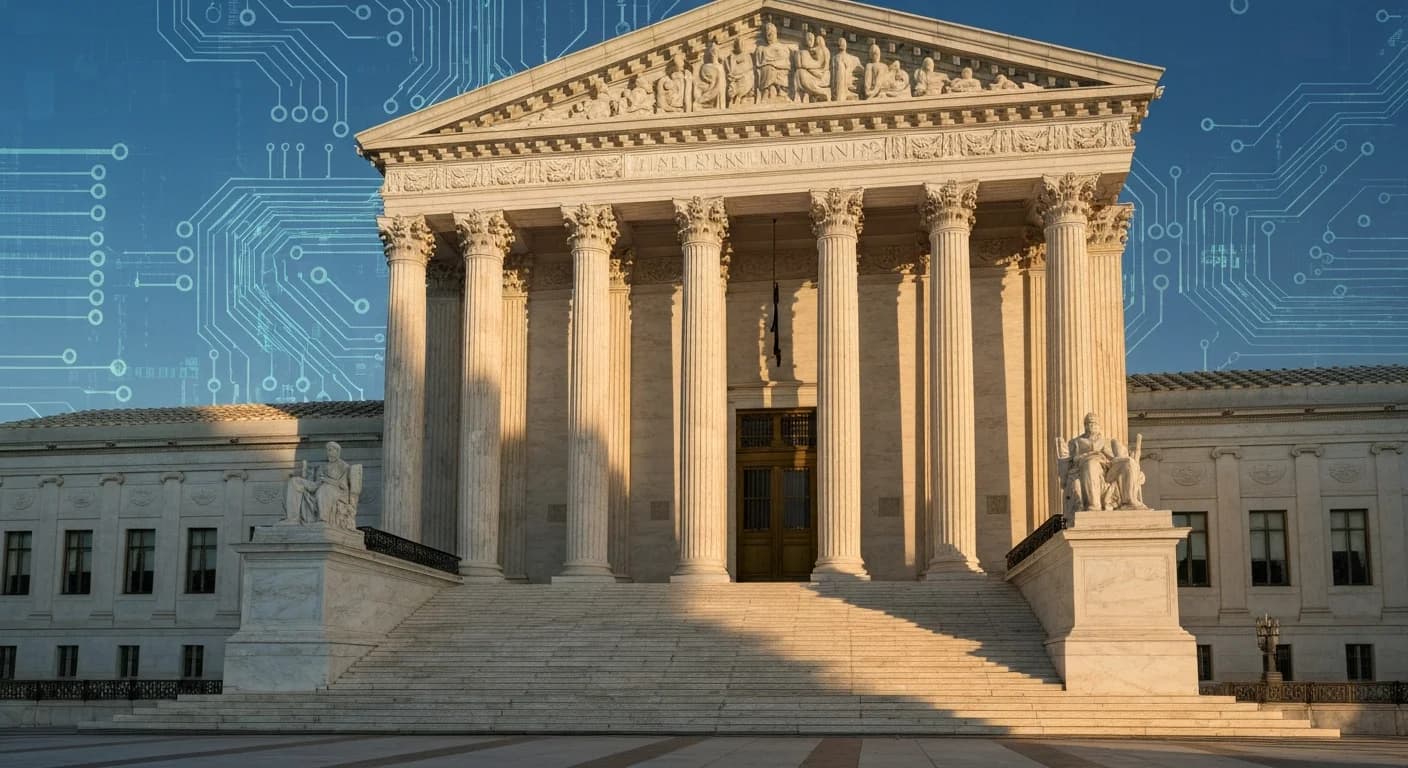
The U.S. Supreme Court has declined to hear Thaler v. Perlmutter, effectively closing the door on copyright protection for artwork generated entirely by artificial intelligence. The decision, announced in early March, leaves intact lower court rulings that establish human authorship as a bedrock requirement of U.S. copyright law.
The case has been closely watched by the AI industry, artists, and legal scholars as a bellwether for how intellectual property law will adapt to the age of generative AI.
The Case History
Stephen Thaler, a computer scientist, applied for a copyright in 2018 for an artwork titled "A Recent Entrance to Paradise," which was generated entirely by his AI system called DABUS. The U.S. Copyright Office rejected the application on the grounds that the work lacked a human author.
Thaler challenged the rejection in federal court, but District Judge Beryl Howell ruled against him in August 2023, writing that human authorship is a "bedrock requirement of copyright." The D.C. Circuit Court of Appeals upheld that decision, and Thaler's final appeal to the Supreme Court has now been denied.
What It Means
By declining to hear the case, the Supreme Court has not issued a formal opinion on AI and copyright. However, the practical effect is the same: the human authorship requirement stands, and there is no remaining legal path to challenge it through the Thaler case.
This creates a clear rule for the current moment. Artwork, music, writing, or other creative works generated entirely by an AI system without meaningful human creative contribution cannot receive copyright protection in the United States.
The Gray Area
The ruling leaves a significant gray area for AI-assisted works. Many artists and creators use AI tools as part of their creative process — generating initial concepts, variations, or elements that are then refined through human judgment and skill. The Copyright Office has issued guidance suggesting that works involving substantial human creative input can still be registered, but the precise line between "AI-generated" and "AI-assisted" remains legally unclear.
Industry Impact
The decision arrives at a pivotal moment for the creative industries. Generative AI tools are now capable of producing high-quality images, music, and text, and businesses are increasingly relying on them for commercial content. Without copyright protection, companies using purely AI-generated material may find their outputs freely replicable by competitors.
This could push the industry toward hybrid workflows where human involvement is maintained not just for quality but for legal protection. It may also accelerate calls for new legislation specifically addressing AI-generated works.
Looking Ahead
Congress has held multiple hearings on AI and copyright but has not yet passed legislation. Several bills have been proposed that would create a new category of protection for AI-generated works, though none have gained significant traction. Until Congress acts, the human authorship requirement established by the courts will remain the law of the land.