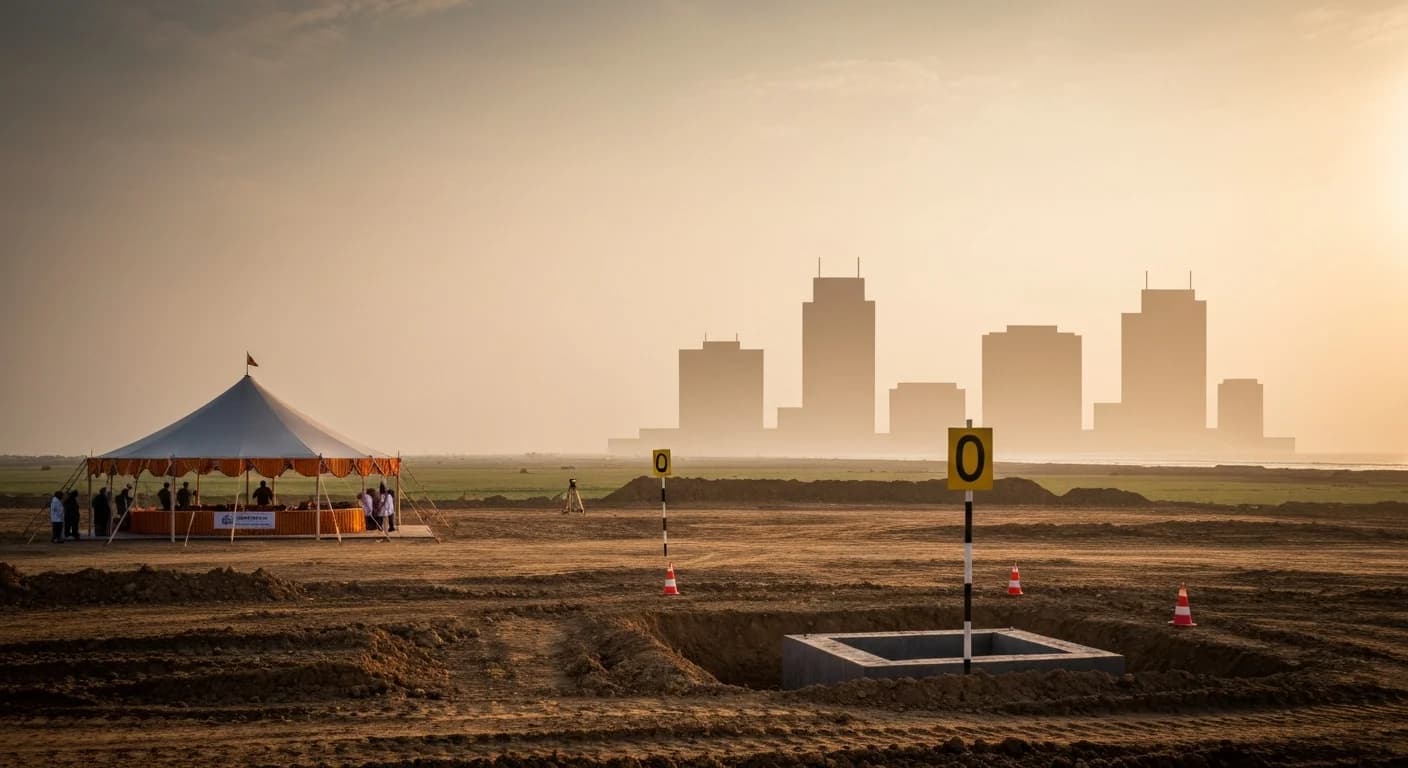
Google formally broke ground on its $15 billion artificial intelligence data centre in Visakhapatnam on Tuesday, marking one of the largest single foreign direct investments ever committed to India and the company's first dedicated AI hub in the country. Andhra Pradesh Chief Minister N. Chandrababu Naidu laid the foundation stone alongside Union IT Minister Ashwini Vaishnaw, Union Ministers Ram Mohan Naidu Kinjarapu, Pemmasani Chandrasekhar and Srinivasa Varma, and State IT Minister Nara Lokesh.
A 1-gigawatt campus, scaling to 5 GW
The campus will sit on roughly 600 acres spread across three locations — Rambilli, Adavivaram and Tharluwada — and will launch with 1 gigawatt of capacity. Google and its partners have set a longer-term target of 5 GW, a figure that, according to reporting around the announcement, is more than three times India's total data centre capacity at the end of 2025. The project was first unveiled in October 2025 as a partnership with the Andhra Pradesh government.
Naidu urged Google and the project's partners to complete the build for inauguration by September 2028. "Unforgettable in Andhra Pradesh history — April 28, 2026 — will be remembered forever in the history of India and in the history of Andhra Pradesh. Google AI data centre will be a growth engine for India," he said at the ceremony.
Adani and Airtel handle the heavy lifting
Google is not building the campus alone. AdaniConneX is responsible for the core data-centre infrastructure, including gigawatt-scale facility design, renewable-energy-linked power systems, transmission lines and energy storage. Bharti Airtel's Airtel Nxtra arm is building the high-capacity fibre network and a new international subsea cable landing station in Vizag, intended to provide low-latency connectivity for Google Cloud and AI workloads across India.
Vaishnaw framed the project as a generational catalyst for the city. "I think Visakhapatnam will be reborn as AI-Patnam. Like Cyberabad, it will become AI-Patnam," he said, drawing a parallel to how Hyderabad's Cyberabad zone reshaped India's IT economy in the 2000s.
Why it matters
The Vizag campus lands at a moment when hyperscaler capex is the single biggest swing factor for the AI industry. Google parent Alphabet is expected to spend $175–185 billion globally on capex this year, and roughly three-quarters of hyperscaler spending in 2026 is going toward AI infrastructure. Routing a meaningful slice of that capital into India — rather than the United States, Europe or Southeast Asia — is a signal that Google sees the country as a long-duration training and inference market, not just a downstream consumer of US-built models.
For Andhra Pradesh, the immediate dividends are workforce: announced programs include training for more than 1,000 infrastructure workers, skilling of 1,200-plus students in cloud and AI, and business support for over 10,000 women entrepreneurs. For India's AI ambitions, the stakes are larger — a domestic gigawatt-class campus reduces the country's dependence on foreign compute at exactly the moment that sovereign-AI policy is moving from rhetoric into procurement.