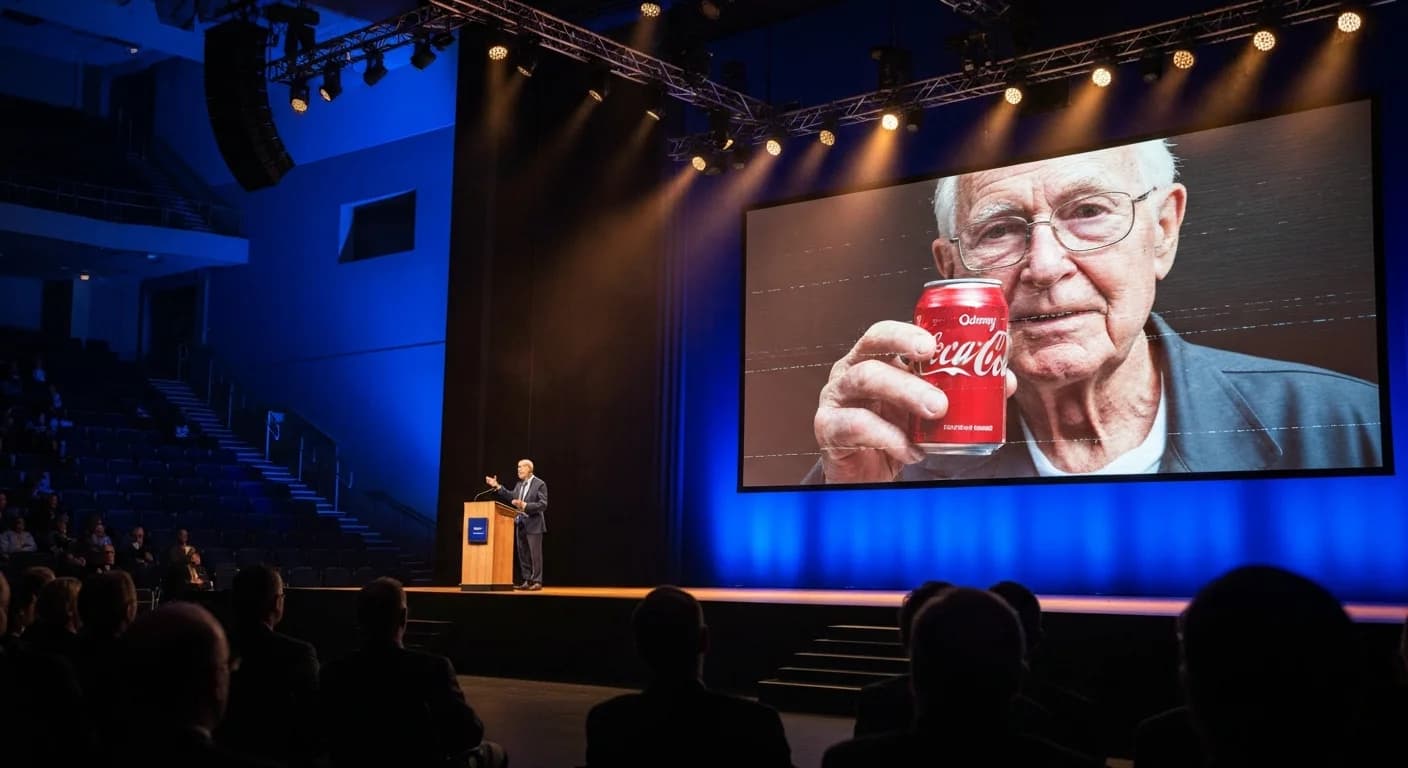
Berkshire Hathaway's first annual meeting of the post-Buffett era opened with an unsettling moment. As the Q&A session began on Saturday in Omaha, the giant screens showed a familiar figure — 95-year-old Warren Buffett, sipping a Cherry Coke, asking shareholders why they should keep holding the stock for the long haul. Then new CEO Greg Abel cut in: the clip was a deepfake, generated by Berkshire's own team using only publicly available material.
"That was a deepfake," Abel told the audience. "We were able to obtain that with information that's out there, and replicate those actions and that voice." He framed the stunt as a live demonstration of the kind of cyber risk Berkshire's businesses now confront daily, and as a warning to shareholders about what generative AI has made trivially easy.
A staged demo with a serious message
The deepfake mimicked Buffett's cadence, mannerisms and trademark Cherry Coke shtick well enough that many in the room appeared to take it at face value before Abel pulled back the curtain. Buffett himself was not involved in producing the clip, according to Abel — the team had simply scraped enough public footage and audio to reconstruct him.
Berkshire's most recent annual report already lists cybersecurity as the second item in its risk factors, citing exposure to viruses, malicious code, unauthorized access, phishing and denial-of-service attacks that could cause service disruptions and reputational damage. Saturday's stunt put a face on that paragraph.
Buffett: 'particularly scary'
Buffett, who handed the CEO title to Abel at the start of the year but remains chairman, returned to the AI theme later in the session. He called the technology "scary," adding that it is "particularly scary when you have nine countries or so with nuclear weapons and people working on it." He has previously warned that deepfake-driven fraud could become "the growth industry of all time."
Vice chairman Ajit Jain, who oversees Berkshire's vast insurance operations, struck a more measured tone. AI could eventually be a "game changer," he said, but its ability to handle complex tasks such as stock picking is "still years away." Berkshire's insurance underwriting exposure to AI-enabled fraud — synthetic identities, voice-cloned wire transfers, deepfake CEO calls — is one reason the topic dominated more of the meeting than in past years.
Abel's posture: selective, not euphoric
Abel used his first turn at the conference to set expectations on AI strategy. Berkshire is "thinking critically about how to use AI to add value," he said, but the company is not "going to do AI for the sake of AI." That fits the conglomerate's playbook of letting operating subsidiaries — BNSF, GEICO, Berkshire Hathaway Energy — adopt technology when it clearly improves underwriting, logistics or maintenance, rather than from the top down.
The optics matter beyond Berkshire. With OpenAI, Anthropic and a handful of hyperscalers driving AI capex toward record highs, an Abel-led Berkshire opening its first meeting with a deepfake demonstration sends a different signal to corporate America: the most consequential near-term AI question for many boards may be defensive, not offensive — how to keep their executives, customers and balance sheets from being convincingly impersonated.