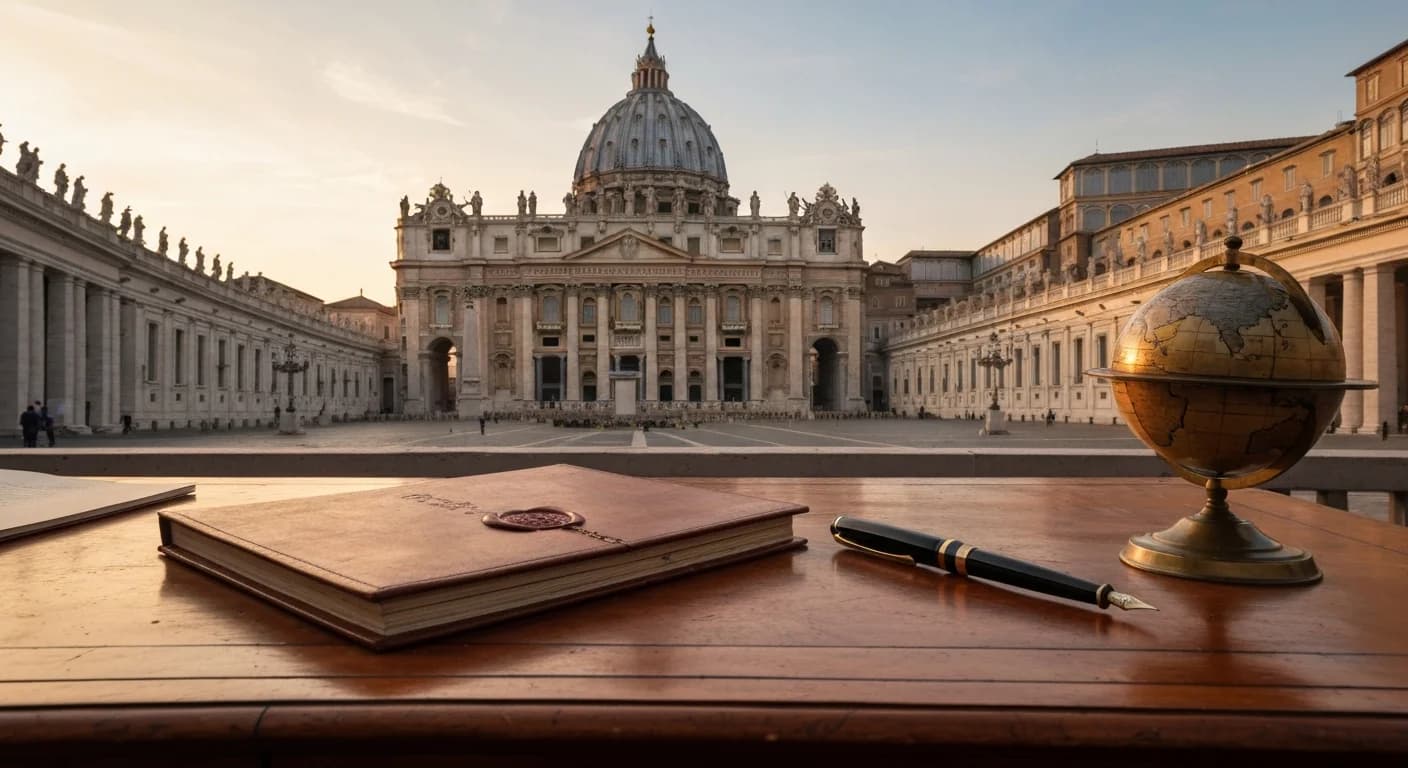
Pope Leo XIV has created an in-house Vatican study group on artificial intelligence, the Holy See announced on May 16, 2026, one day after he signed his first encyclical — a document expected to place AI at the center of modern Catholic social teaching.
The Vatican said the pope decided to establish the group because of the acceleration in AI's use, "its potential effects on human beings and on humanity as a whole (and) the church's concern for the dignity of every human being." The Holy See's Press Office told reporters that the formal announcement about the encyclical will take place on May 22, with release in the coming weeks.
A successor to Rerum Novarum
Leo signed the encyclical on May 15, 2026 — 135 years to the day after his namesake, Pope Leo XIII, dated Rerum Novarum ("Of New Things"), the 1891 text that became the foundation of Catholic social teaching on labor, capital, and industrial change. The deliberate timing reframes the new document as a successor for the AI era. According to the Vatican, the encyclical will focus on AI's impact on "people and working conditions," placing the technology within the church's longstanding social teaching on labor, justice, and peace.
Ethics, dignity, and warfare
Leo's interventions on AI to date have emphasized ethics, human dignity, and peace. He has also called for monitoring how AI is used and developed in warfare, pointing to ongoing conflicts in Ukraine, Gaza, Lebanon, and Iran, where automated weapons systems — aerial drones and autonomous maritime and ground platforms — have become routine. The new study group is expected to formalize the Vatican's research footprint on those questions rather than rely solely on external advisory work.
Meghan Sullivan, a philosophy professor at the University of Notre Dame who directs its ethics institute, told reporters: "I think that the Catholic Church in many ways is going to be the adult in the room on some of these debates."
Why it matters for the AI industry
The Vatican has been engaging with AI companies for years. Microsoft and IBM were among the original signatories of the "Rome Call for AI Ethics" in February 2020, with Cisco joining in 2024, and Leo's predecessors have repeatedly met with executives from leading AI labs. A papal encyclical, however, carries different weight than a non-binding declaration: it sets durable doctrine for the global Catholic Church and tends to be cited heavily in international policy debates.
For an industry currently navigating EU AI Act enforcement, U.S. executive-branch pre-release testing agreements with companies including Microsoft, Google, and xAI, and ongoing scrutiny of products like Elon Musk's Grok and Nvidia's H200 export profile, a sustained Vatican voice adds another normative pressure point — one that frames AI primarily as a question about workers, dignity, and peace rather than capability and capital.
The study group's composition, leadership, and reporting line have not yet been disclosed.