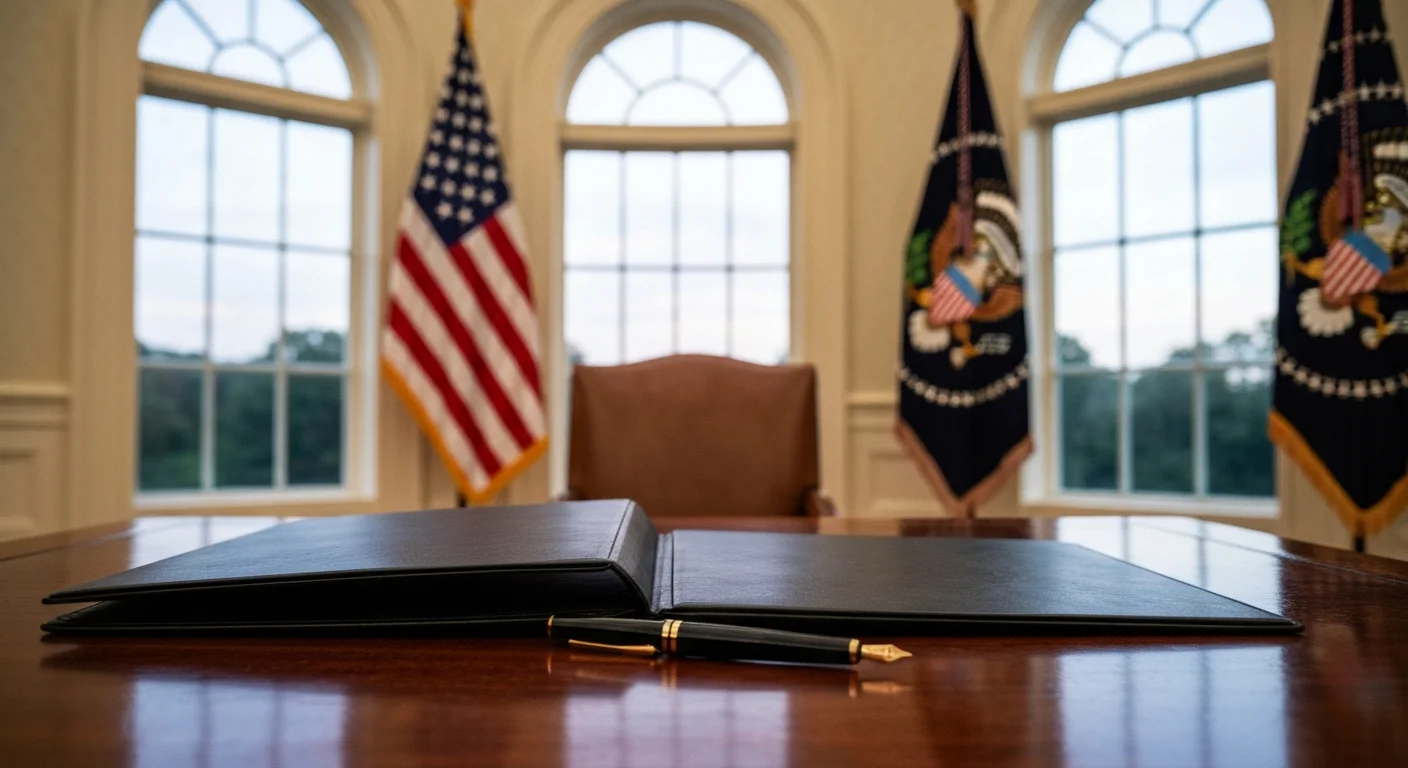
President Trump on Thursday abruptly postponed the signing of an AI security executive order that would have required frontier labs to hand advanced models to the federal government 14 to 90 days before public release. The signing was scheduled for Thursday afternoon; Trump told reporters in the Oval Office he scrapped it because "I didn't like certain aspects of it" and worried the language "could have been a blocker."
What the order would have mandated
The draft framework went well beyond today's voluntary posture. Per reporting on the language, it would have:
- Required AI companies to share advanced models with the government 14 to 90 days ahead of launch.
- Tasked the Office of the National Cyber Director and other agencies with building a process to evaluate models for security vulnerabilities before release.
- Given federal agencies up to 90 days to complete that review.
In practice, that converts a hands-off regime into a structured pre-deployment gate — with a review window long enough to slip a major model launch by a full quarter.
Why now: Mythos and GPT-5.5 Cyber
The order was reportedly motivated by recent releases, including Anthropic's Mythos and OpenAI's GPT-5.5 Cyber, both described as capable of rapidly identifying and exploiting security vulnerabilities. The administration had taken a largely hands-off stance on AI until those cyber-capable models sharpened national-security concerns.
The CAISI regime stays in place
Even without the order, the Center for AI Standards and Innovation (CAISI), housed under the Commerce Department, already runs voluntary pre-deployment testing. On May 5, Google DeepMind, Microsoft and xAI signed agreements, joining OpenAI and Anthropic — which signed similar deals roughly two years ago under the Biden-era US AI Safety Institute. Five frontier labs now participate, and CAISI has completed more than 40 assessments, sometimes testing models with safeguards reduced or removed and in classified environments.
Trump's calculus
"We're leading China, we're leading everybody, and I don't want to do anything that's going to get in the way of that leading," Trump said. Reports also flagged a more prosaic reason: too few tech CEOs were available for the signing-ceremony photo op on short notice. The shelved order is separate from the December 2025 executive order targeting state AI laws, which was signed.
What changes for builders
For now, nothing binding — release cadence stays governed by voluntary CAISI agreements, not a mandatory 14-to-90-day clock. But the draft signals where US policy is heading. If revived, a pre-release review window would directly reshape launch timelines, API availability dates, and enterprise procurement planning around frontier models. Teams building on frontier APIs should treat a government review gate as a live scenario for late-2026 roadmaps, even though Thursday's reversal buys the labs more runway.