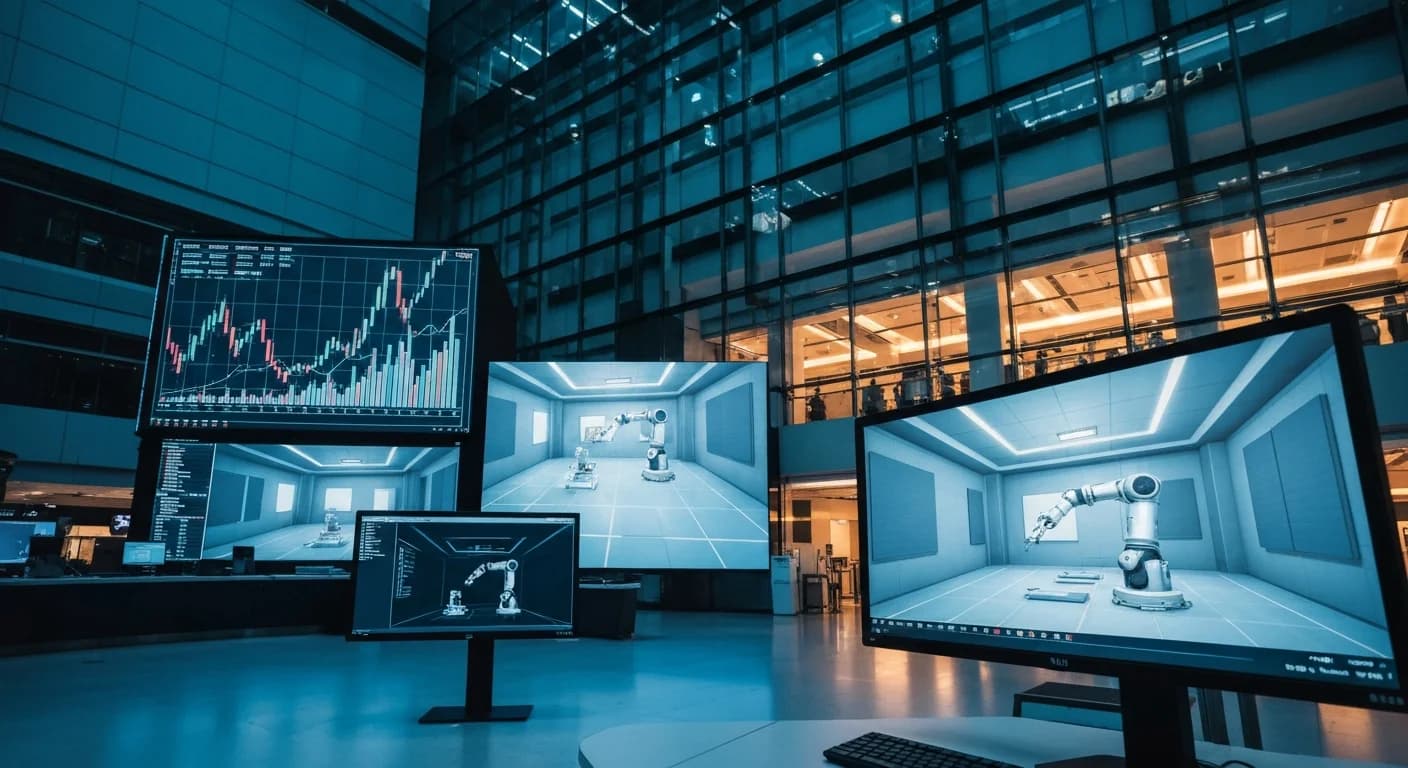
Manycore Tech rang the bell at the Hong Kong Stock Exchange on April 17, 2026 and promptly became the best-performing Asian tech debut of the month. The Hangzhou company's shares closed at HKD 18.60, roughly 144% above the HKD 7.62 offer price, turning a $156 million IPO into an instant stress test for public-market appetite for Chinese AI infrastructure plays.
Trading under the ticker 00068.HK, Manycore also claimed a more novel title: the world's first publicly listed "spatial intelligence" company. That label — popularized in the past year by researchers building AI systems that reason about 3D worlds — now has a pure-play stock attached to it.
From design software to robot training data
Founded in 2011, Manycore started life as a GPU-powered cloud platform for interior designers and architects. Over time, its library of interactive 3D environments ballooned to more than 500 million assets, according to company disclosures — a corpus that is increasingly valuable for something very different: training the embodied AI systems that power humanoid robots and autonomous machines.
The company has signed commercial partnerships with Hesai Technology, one of the world's largest lidar suppliers, and Shanghai-based humanoid robotics firm AgiBot. In both cases, Manycore's role is to supply synthetic 3D scenes and simulation-ready data that robot makers can use to train perception and manipulation models before deploying them in the physical world.
Hangzhou's first 'Little Dragon' goes public
Manycore is also the first of the so-called "Hangzhou Six Little Dragons" — a cohort of fast-growing Chinese AI and robotics startups — to hit the public markets. That symbolism was not lost on investors. Bloomberg reported that the founding team includes a former Nvidia engineer, and Fortune's coverage framed the debut as a bet on spatial intelligence emerging as a complementary next frontier to large-language-model investment — attracting capital as part of a diversifying AI landscape.
HKEX filings show net proceeds of about HKD 1.09 billion, earmarked for expanding the company's 3D asset library, scaling its GPU compute footprint, and pushing into overseas markets where demand for robot training data is accelerating.
Implications: a new asset class for AI
For investors, Manycore's debut draws a sharp line between two AI categories. Pure foundation-model companies are largely still private and increasingly expensive. Spatial intelligence vendors, by contrast, sit in the middle of the robotics supply chain — selling data and simulation infrastructure to every humanoid, autonomous-vehicle, and warehouse-automation startup in the pipeline.
If the Manycore pop holds, expect other "Little Dragons" — and Western counterparts pitching 3D data and world models — to accelerate their own listing plans. A public comp for spatial intelligence now exists, and it opened with a 144% gain.